
What Causes Rainbows?
The Big Idea
Discover how millions of tiny raindrops act as microscopic prisms. Learn how they bend and reflect sunlight to paint a colorful masterpiece across the sky, and why you can only see a rainbow when the sun is behind you.
Key Vocabulary & Concepts

Hands-On Observation Checklist
Teacher & Parent Discussion Starters
- Why is understanding what causes rainbows? important in everyday real life?
- What variable or factor had the biggest impact when testing the simulation?
- How does this concept connect to another science topic you have learned about?
What Causes Rainbows?
The Masterpiece After the Storm
There is nothing quite as magical as the moment a storm finally clears. The dark, heavy clouds break apart, the golden sun begins to peek through, and suddenly, a massive, vibrant arc of color stretches across the entire sky.
For thousands of years, people thought rainbows were magical bridges to other worlds or divine signs from the gods. But the truth is even more fascinating. A rainbow is a beautiful, large-scale physics experiment that requires exactly two ingredients: Bright Sunlight and Millions of Raindrops.
A breathtaking cinematic photograph of a vibrant double rainbow stretching across a misty mountain valley
The Microscopic Mirror
To see a rainbow, you must be standing in the perfect position—with the bright Sun directly at your back and the rain falling directly in front of you.
When a single ray of "white" sunlight hits a falling raindrop, something incredible happens. As the light enters the curved surface of the water, it slows down and physically bends—a process called Refraction.
Inside the drop, the light doesn't just pass through. It hits the back wall of the raindrop and bounces off it like a tiny mirror, a process called Reflection. Finally, the light exits the front of the drop, bending one last time as it returns to the air.
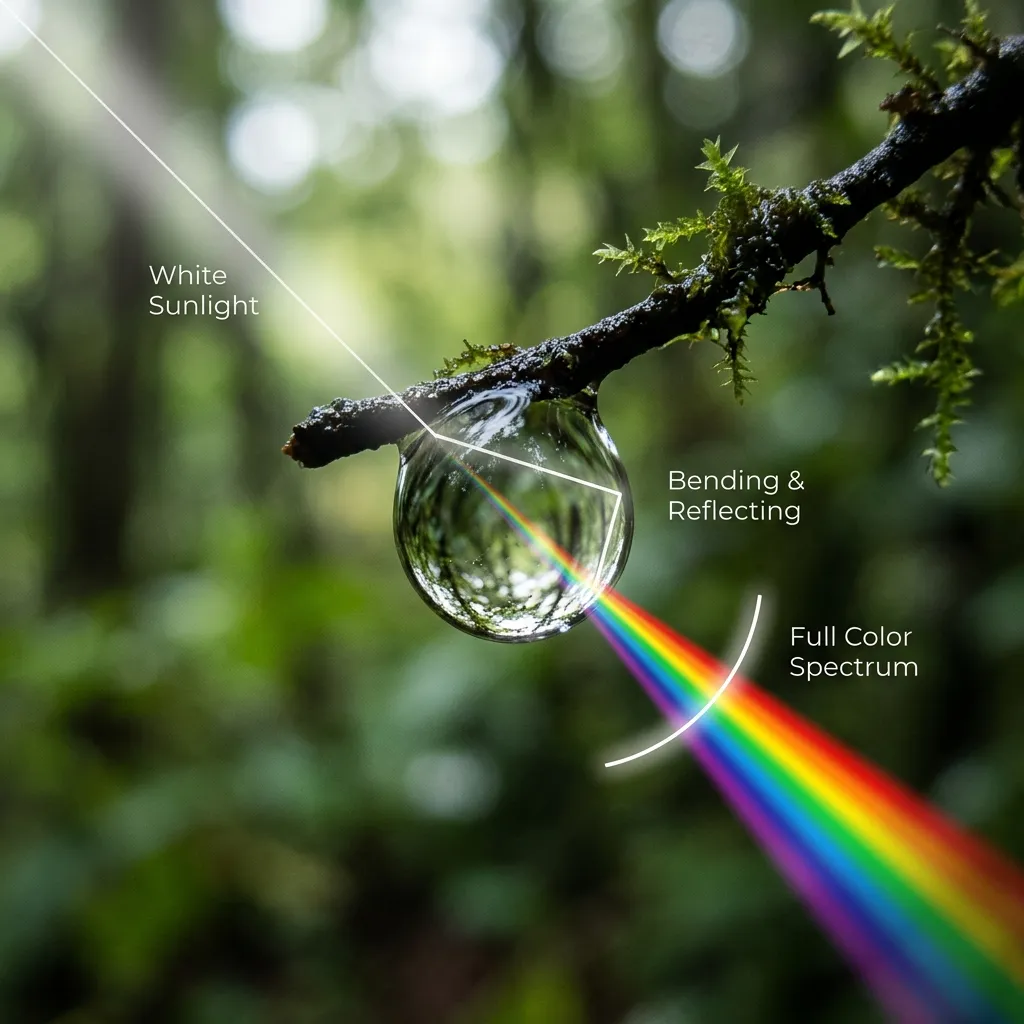 A beautiful cinematic illustration of a raindrop bending and reflecting sunlight into a full color spectrum
Separating the Colors
Wait—if the Sun's light is white, why is the rainbow so colorful?
Sunlight looks white to our eyes, but it is actually a hidden mixture of every color in existence: Red, Orange, Yellow, Green, Blue, Indigo, and Violet.
Inside the raindrop, each of these colors travels at a slightly different speed. Because they move differently, they also bend at slightly different angles. Red light is stubborn and bends the least, while Violet light is very flexible and bends the most. This physical difference separates the colors, spreading them out into the beautiful, orderly spectrum we see in the sky.
The Moving Illusion
The most mind-blowing thing about a rainbow is that it isn't actually a physical "thing" sitting in a specific spot. It is an optical phenomenon that exists only in your eyes!
Because the rainbow relies on the very specific angle of the sunlight hitting the water (about 42 degrees), it moves whenever you move. If you try to chase a rainbow to find the "end," it will simply move further away at the exact same speed. In fact, every single person standing on the beach is seeing their own unique, personal rainbow created by a different set of raindrops!
You aren't just looking at a painting in the sky; you are looking at a living, moving interaction between light and water that exists purely because you are there to see it.