
What Is a Black Hole?
The Big Idea
Journey into the darkest, most mysterious objects in the universe. Discover how gravity becomes so strong that time freezes and light itself cannot escape, and learn what would happen if you ever fell into one.
Key Vocabulary & Concepts
Hands-On Observation Checklist
Teacher & Parent Discussion Starters
- Why is understanding what is a black hole? important in everyday real life?
- What variable or factor had the biggest impact when testing the simulation?
- How does this concept connect to another science topic you have learned about?
What Is a Black Hole?
The Dark Star
In the vast, freezing darkness of deep space, there are monsters. They are the most extreme, violent, and utterly mysterious objects in the known universe. We call them Black Holes.
A black hole is a heavy object. Actually, that is a massive understatement. It is an object so dense, so unbelievably heavy, that its mere existence shatters the laws of physics. Its gravity is so strong that absolutely nothing can escape its violent grip. Not a speeding rocket, not a massive planet, and not even light itself.
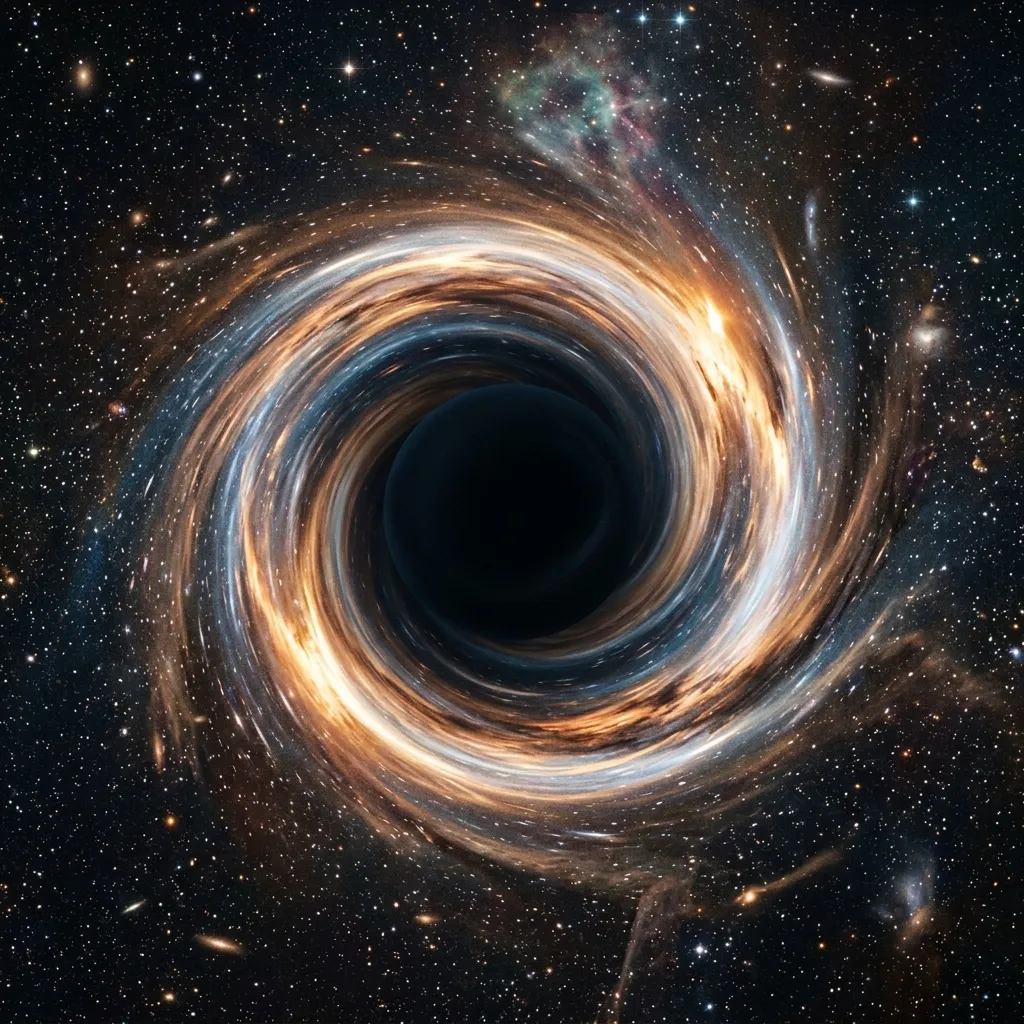
Because light cannot bounce off of it and escape, the hole is completely invisible to our eyes. It is a perfect, flawless black sphere—a terrifying silhouette of nothingness stamped against the starry sky.
A breathtaking visualization of a massive, swirling black hole bending starlight in deep space
The Death of a Giant
How are these monsters born? They are the heavy ghosts of dead, giant stars.
Normally, a living star is a perfect balance of two opposing forces.
- Gravity is desperately trying to crush the massive weight of the star inward.
- Fusion (trillions of massive nuclear explosions happening in the core) is pushing violently outward.
For billions of years, it is a perfect stalemate. The star burns bright and stable. But eventually, the nuclear fuel in the core runs out. The outward explosions stop. Gravity finally wins the war.
If the star is massive enough (many times larger than our own sun), it completely collapses under its own weight. The entire mass of the giant star crunches violently inward. It gets smaller and smaller. It crushes down into a super-dense ball the size of a city. Then the size of a bowling ball. Then the size of a marble.
And then... it crushes into a Singularity. It becomes a single point of infinite density. A permanent puncture wound in the fabric of space-time.
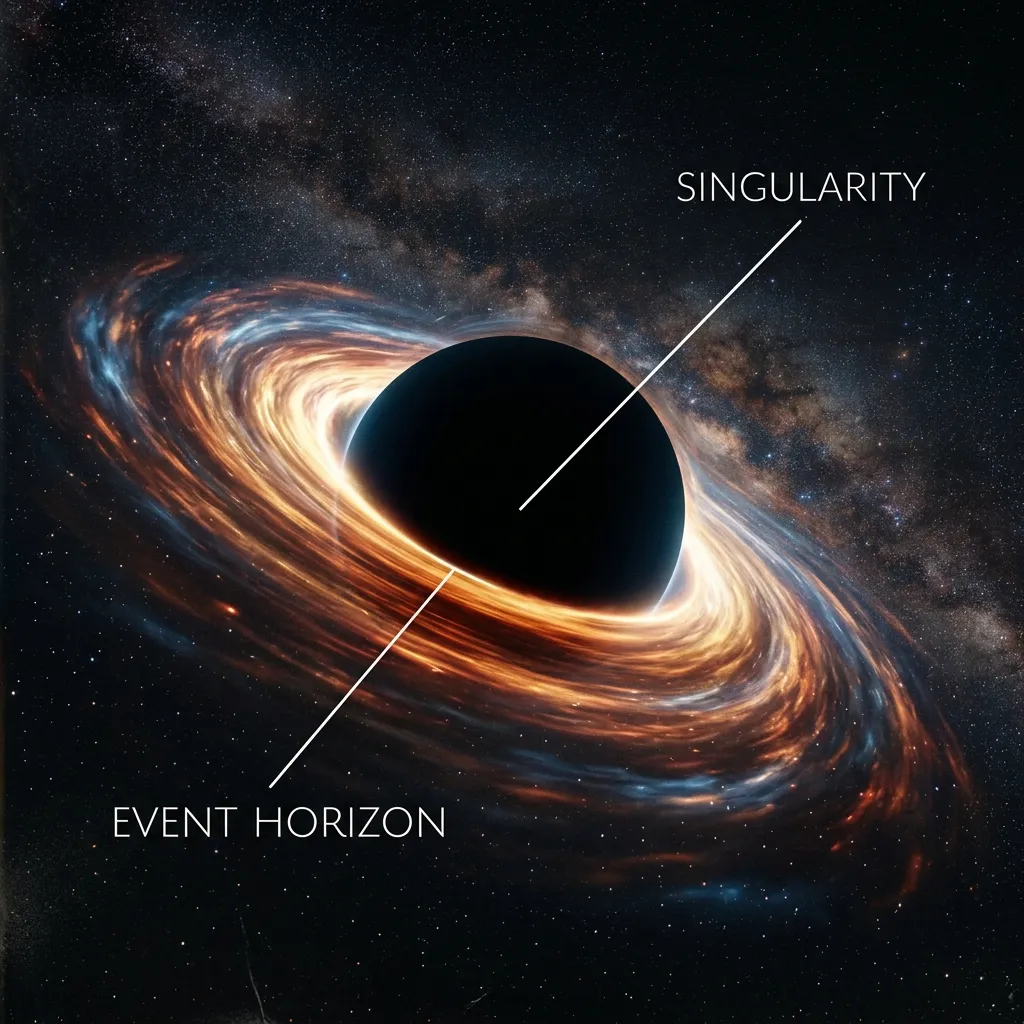 A cinematic visualization of a black hole showing the Event Horizon boundary and the Singularity
The Point of No Return
Surrounding this microscopic singularity is an invisible, spherical boundary called the Event Horizon.
Think of the Event Horizon like the edge of a massive, roaring waterfall. If you are swimming in the river far above the falls, you can easily paddle away to safety. But past a certain line in the water, the current becomes faster than any human can physically swim. Once you accidentally drift across that invisible line, you are going over the edge. There is no coming back.
The Event Horizon is that exact line in space. To escape its gravitational pull, you would need to hit an escape velocity faster than the speed of light. Since the ultimate speed limit of the universe dictates that absolutely nothing can travel faster than light, escape is impossible. Once you cross the Event Horizon, you belong to the black hole forever.
Spaghettification
What actually happens to your body if you fall in? It isn't pretty. In fact, astronomers have a highly technical (and slightly funny) term for it: Spaghettification.
Gravity gets drastically stronger the closer you get to the source. If you fell feet-first toward a black hole, your feet would be slightly closer to the singularity than your head. Normally, on Earth, this difference in distance is so tiny it doesn't matter. But near the edge of a black hole, gravity is millions of times stronger. The violent pull on your feet would be infinitely stronger than the pull on your head.
Your entire body would be viciously stretched. Your bones would snap, your muscles would tear, and eventually, you would be drawn out into a single, long, thin strand of atoms—stretching down into the darkness exactly like a piece of spaghetti.
Time Travels
If the physical tearing wasn't terrifying enough, black holes also break the flow of Time.
Albert Einstein taught us that massive gravity physically bends both space and time. The stronger the gravity, the slower time moves. If you were floating safely in a spaceship and watched a friend accidentally fall into a black hole, you would never actually see them cross the Event Horizon.
As they got closer and closer to the terrifying edge, the intense gravity would cause their time to slow down from your perspective. You would see them move in extreme, agonizing slow motion. Then, right at the absolute edge of the Event Horizon, they would appear to freeze entirely. They would slowly fade into a dark redness as the light reflecting off them struggled to climb out of the gravity well.
To them, they fell into the dark in a fraction of a second. But to you, they are frozen there forever—a ghost caught permanently on the edge of eternity.