
What Is A Shooting Star?
The Big Idea
Discover the fiery physics behind the streaks of light in the night sky. Learn how tiny space rocks traveling at thousands of miles per hour burn up as they crash into Earth’s atmosphere.
Key Vocabulary & Concepts
Hands-On Observation Checklist
Teacher & Parent Discussion Starters
- Why is understanding what is a shooting star? important in everyday real life?
- What variable or factor had the biggest impact when testing the simulation?
- How does this concept connect to another science topic you have learned about?
What Is A Shooting Star?
You are lying on a blanket on a dark, moonless summer night, watching the tranquil constellations. Suddenly, a brilliant streak of silver-white fire cuts across the stars, flashing intensely before vanishing into the darkness.
"Make a wish!" someone shouts. "A shooting star!"
It is one of the most magical sights in astronomy. But here is the ultimate cosmic spoiler: you did not just see a star.
Real stars, like our Sun or Alpha Centauri, are colossal spheres of roiling nuclear plasma hundreds of thousands of times larger than Earth. If an actual star shot through our atmosphere, our entire solar system would be vaporized in a microsecond!
What you witnessed was a meteor—and surprisingly, that dazzling streak of celestial fire was likely produced by a piece of space debris no larger than a single grain of sand or a dry pea!
The Three Names of a Space Rock
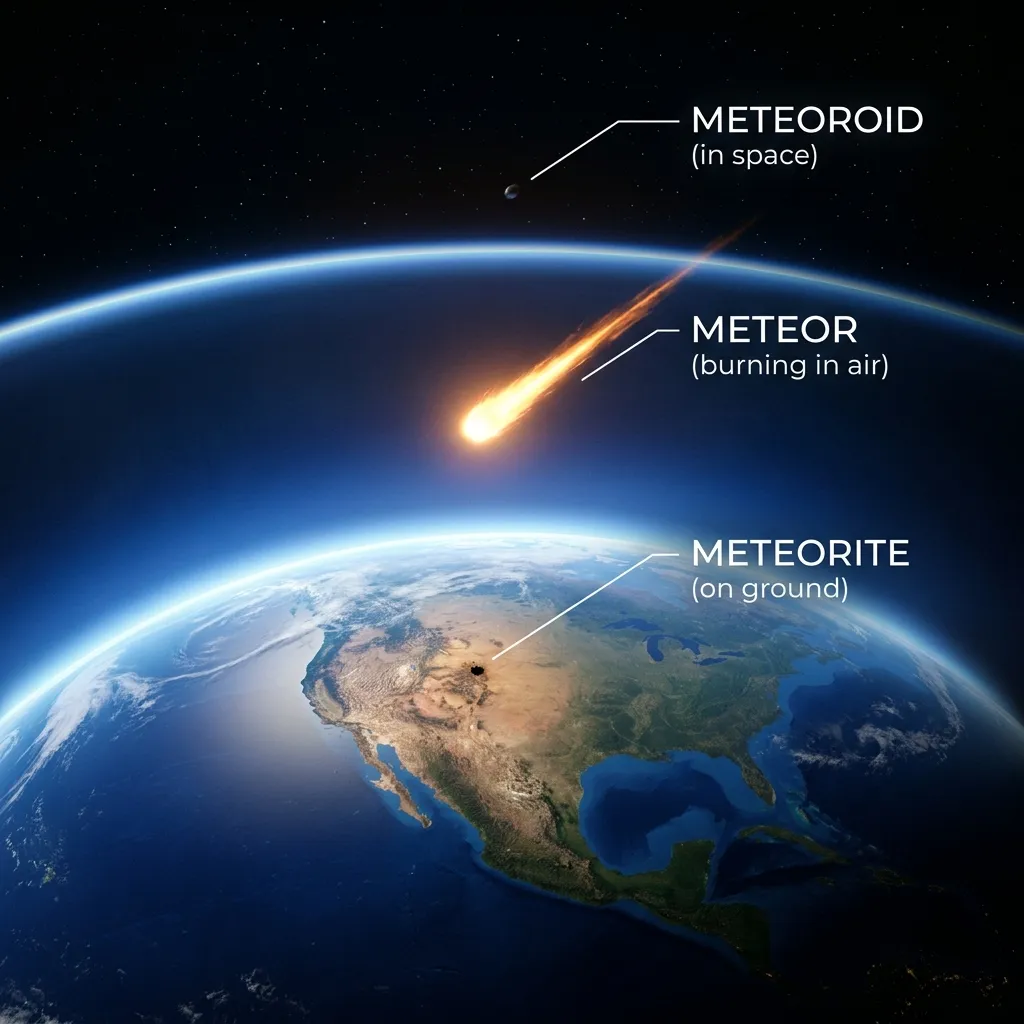
Astronomers use three different names depending on where the space rock is located:
- Meteoroid: The rock while it is silently cruising through the freezing vacuum of space. Most are chipped-off fragments of asteroids or dusty debris shed by passing comets.
- Meteor: The incandescent streak of light you see when a meteoroid enters Earth's atmosphere and vaporizes. This is the "shooting star."
- Meteorite: Any rare, hardy chunk that survives the fiery plunge and actually lands on Earth’s surface.
Celestial Streak: The journey from meteoroid to meteorite
The Physics of the Flash: Ram Pressure
How can a speck of dust no heavier than an eyelash light up an entire county from fifty miles above the ground?
It is all about insane speed.
Out in the solar system, meteoroids orbit the Sun at blistering velocities between 25,000 and 160,000 miles per hour (11 to 72 kilometers per second).
When a rogue grain of dust collides with Earth, it slams into our upper atmosphere—the mesosphere, about 50 to 60 miles (80 to 100 km) high. At those hypersonic speeds, the air molecules cannot move aside in time.
A widespread myth claims that simple surface friction causes the glow. In reality, the primary culprit is ram pressure.
The oncoming meteoroid violently compresses the air directly ahead of it like a supersonic piston. When you compress a gas rapidly, its temperature skyrockets. The cushion of air in front of the space rock instantly superheats to over 3,000°F (1,650°C)!
This intense atmospheric furnace immediately begins stripping the outer layers of the rock away—a process called ablation. The vaporized minerals and superheated atmospheric gases ionize into a glowing trail of white-hot plasma, creating the luminous streak we see from our backyards.
The Rainbow of Cosmic Colors
If you look closely at bright shooting stars, you will notice they are not just white; they glow in a rainbow of vivid colors. The color reveals the rock's chemical recipe:
- Vibrant Emerald Green: Caused by burning nickel or magnesium, common in metallic space rocks.
- Electric Yellow-Orange: Caused by vaporizing sodium atoms.
- Crimson Red: Produced when energetic collisions heat atmospheric nitrogen and oxygen molecules.
- Deep Violet / Purple: Caused by ionized calcium.
Fast Facts About Meteors
- Daily Space Dust: Every single day, Earth's atmosphere is bombarded by roughly 40,000 to 100,000 tons of space dust and microscopic meteoroids! Most burn up harmlessly as microscopic shooting stars.
- Fireballs and Bolides: Exceptionally bright meteors that outshine the planet Venus are called fireballs. If they detonate with an audible sonic boom, astronomers call them bolides.
- Meteor Showers are Comet Trails: Annual meteor showers—like the famous August Perseids or December Geminids—occur when Earth's orbit plows directly through clouds of dusty gravel left behind by ancient passing comets.
- Hunting in Antarctica: The best place on Earth to search for surviving meteorites is the icy blue ice fields of Antarctica. Dark space rocks stand out clearly against the white ice and are preserved like frozen relics in time!
Related Wonders
 Space
How Do Rockets Work in Space?
If space is a total vacuum with no air to push against, how does a massive rocket ship actually move forward? Unlock the secrets of Newton's Third Law and the physics of fire that allow us to reach the stars.
 Space
How Does GPS Work?
Discover the invisible network of satellites orbiting Earth that helps you find your way. Learn how high-tech atomic clocks and complex math allow your phone to pinpoint your exact location anywhere on the planet.
 Space
Quantum Entanglement: Spooky Action
Explore the mind-bending world of quantum physics and 'spooky action at a distance.' Discover how two tiny particles can remain perfectly connected across the universe, sharing information instantly regardless of the distance between them.