
What Is The Fibonacci Sequence?
The Big Idea
Discover the hidden mathematical code that dictates the shape of galaxies and the curve of sunflower seeds. Learn how the Fibonacci sequence provides a blueprint for the most efficient growth patterns in nature.
Key Vocabulary & Concepts
Hands-On Observation Checklist
Teacher & Parent Discussion Starters
- Why is understanding what is the fibonacci sequence? important in everyday real life?
- What variable or factor had the biggest impact when testing the simulation?
- How does this concept connect to another science topic you have learned about?
What Is The Fibonacci Sequence?
The Rabbit Math
In the year 1202, an Italian mathematician named Leonardo Fibonacci was thinking about rabbits. He was writing a massive book on mathematics and decided to pose a strange, hypothetical puzzle:
"If you place two baby rabbits in a field, and rabbits obey simple, perfect rules for reproduction every month, how many rabbits will you have at the end of a year?"
He began to write down the number of rabbit pairs month by month:
- Month 1: 1 pair.
- Month 2: 1 pair.
- Month 3: 2 pairs.
- Month 4: 3 pairs.
- Month 5: 5 pairs.
- Month 6: 8 pairs.
- Month 7: 13 pairs.
He immediately noticed a striking pattern. Each new number was exactly the sum of the two numbers before it. (1+1 = 2), (1+2 = 3), (2+3 = 5), (3+5 = 8).
This endless string of numbers—1, 1, 2, 3, 5, 8, 13, 21, 34, 55...—became known as the Fibonacci Sequence. At first, it just seemed like a fun puzzle for mathematicians to solve on paper. But then, scientists started looking outside. And they realized, to their absolute shock, that nature was following the exact same rules.
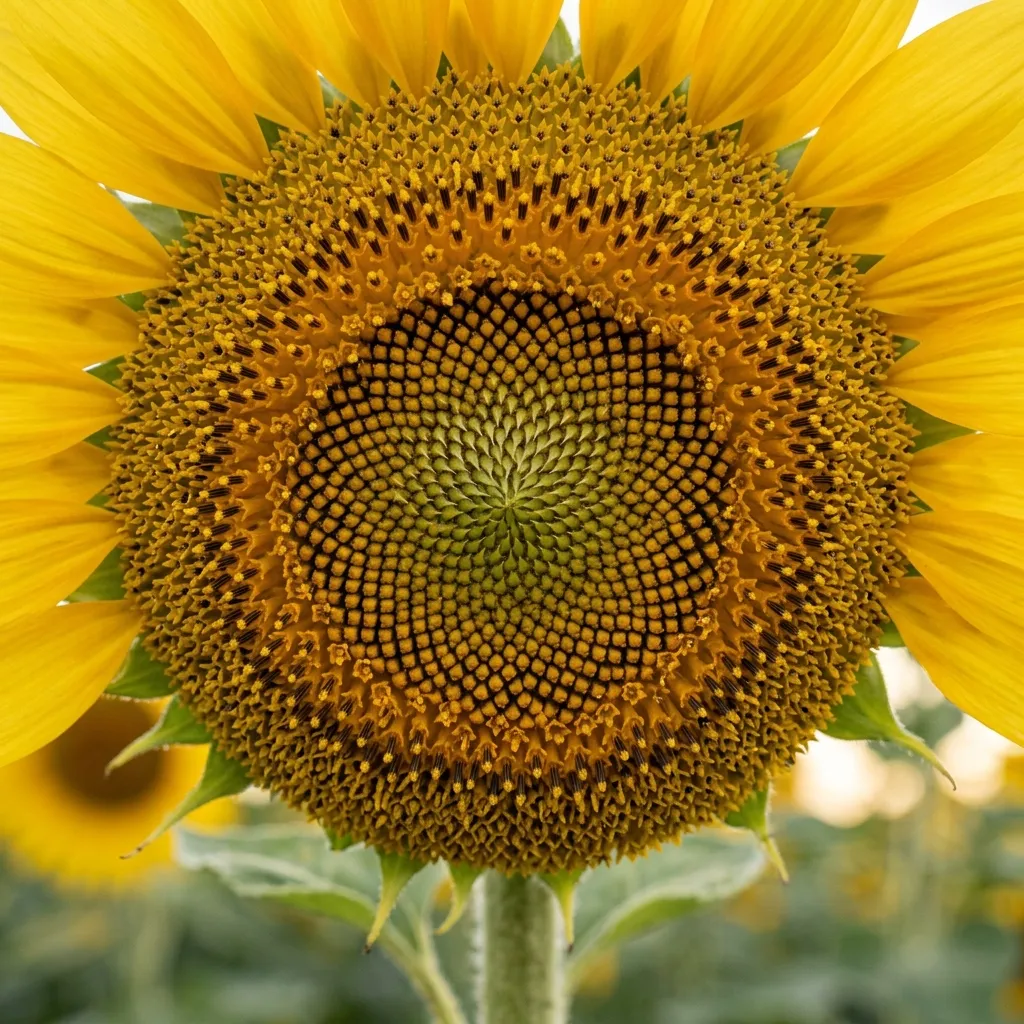
A breathtaking macro photograph of a sunflower center showing perfect Fibonacci spirals
The Secret Code of Flowers
Go outside and look closely at the massive, heavy center of a sunflower. You will see thousands of tiny seeds arranged in mesmerizing, swirling spirals.
If you take the time to count the spirals curving to the left, and then count the spirals curving to the right, you will almost always find two consecutive Fibonacci numbers (for example, 34 spirals leaning left, and 55 spirals leaning right).
Look at the rough scales of a pinecone. Look at the spiky layers of a pineapple. Count the petals on a flower in your garden: Lilies almost always have 3, Buttercups have 5, Delphiniums have 8, and Marigolds have 13.
Why? Is nature secretly brilliant at addition? No. Nature is brilliant at Efficiency.
The Golden Angle
A sunflower wants to pack as many seeds as physically possible into the center of its face without wasting a single millimeter of space. If it grew seeds in straight, boring rows (like corn), there would be massive empty gaps between the spokes.
To pack things perfectly, the plant rotates exactly 137.5 degrees before dropping a new seed. This is known as the Golden Angle. Because it is a highly "irrational" mathematical angle, the seeds never line up perfectly in a straight row. Every single time a new seed pops out, it slots perfectly into an empty gap, filling the space like a flawless biological puzzle.
And guess what mathematical series is required to approximate the Golden Angle? The Fibonacci Sequence.
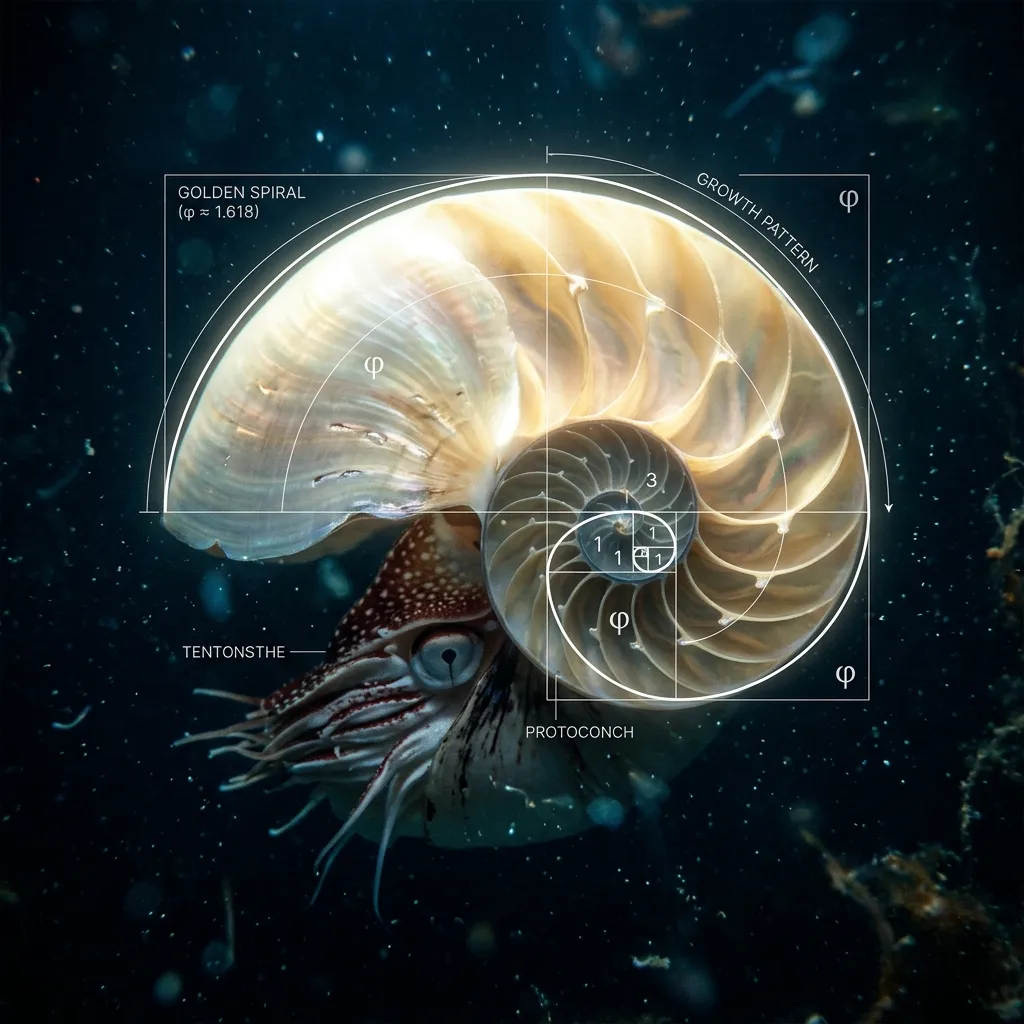 A cinematic illustration of a glowing nautilus shell perfectly mapping the Golden Spiral
The Golden Spiral
When you turn the Fibonacci sequence into a shape, it creates a curve known as the Golden Spiral. It starts tight and flares outward at a constant, accelerating rate.
Because it represents the most efficient way for something to grow without changing its fundamental shape, nature uses this spiral everywhere. You can trace the exact same Fibonacci math curving along the chambers of a deep-sea Nautilus shell, sweeping through the massive white clouds of a Category 5 hurricane, and spinning through the starry arms of the Milky Way galaxy.
The flower and the galaxy are not doing math. They are simply existing in the most efficient way possible. Fibonacci just gave us the code to finally read the hidden blueprint of the universe.