
What Is Lava?
The Big Idea
Journey into the molten heart of a volcano to discover the secrets of lava. Learn how underground magma transforms as it reaches the surface, and how it cools to create brand new land.
Key Vocabulary & Concepts
Hands-On Observation Checklist
Teacher & Parent Discussion Starters
- Why is understanding what is lava? important in everyday real life?
- What variable or factor had the biggest impact when testing the simulation?
- How does this concept connect to another science topic you have learned about?
What Is Lava?
When you watch a volcanic eruption on video, it looks like a rushing river of liquid flame. It glows with a dazzling, incandescent orange light, incinerating trees in seconds, boiling ocean water into steam, and melting through solid metal.
Yet despite its fiery appearance, lava is not fire. Fire is a chemical reaction involving burning gases and oxygen.
Lava is something much heavier and more primordial: it is pure, liquefied stone.
It is the very foundation of our planet melted down into an incandescent liquid slush raging between 1,300°F and 2,200°F (700°C to 1,200°C). But where does this molten rock come from, and why does it sometimes ooze like honey while other times exploding like a bomb?
Magma vs. Lava: The Great Name Change
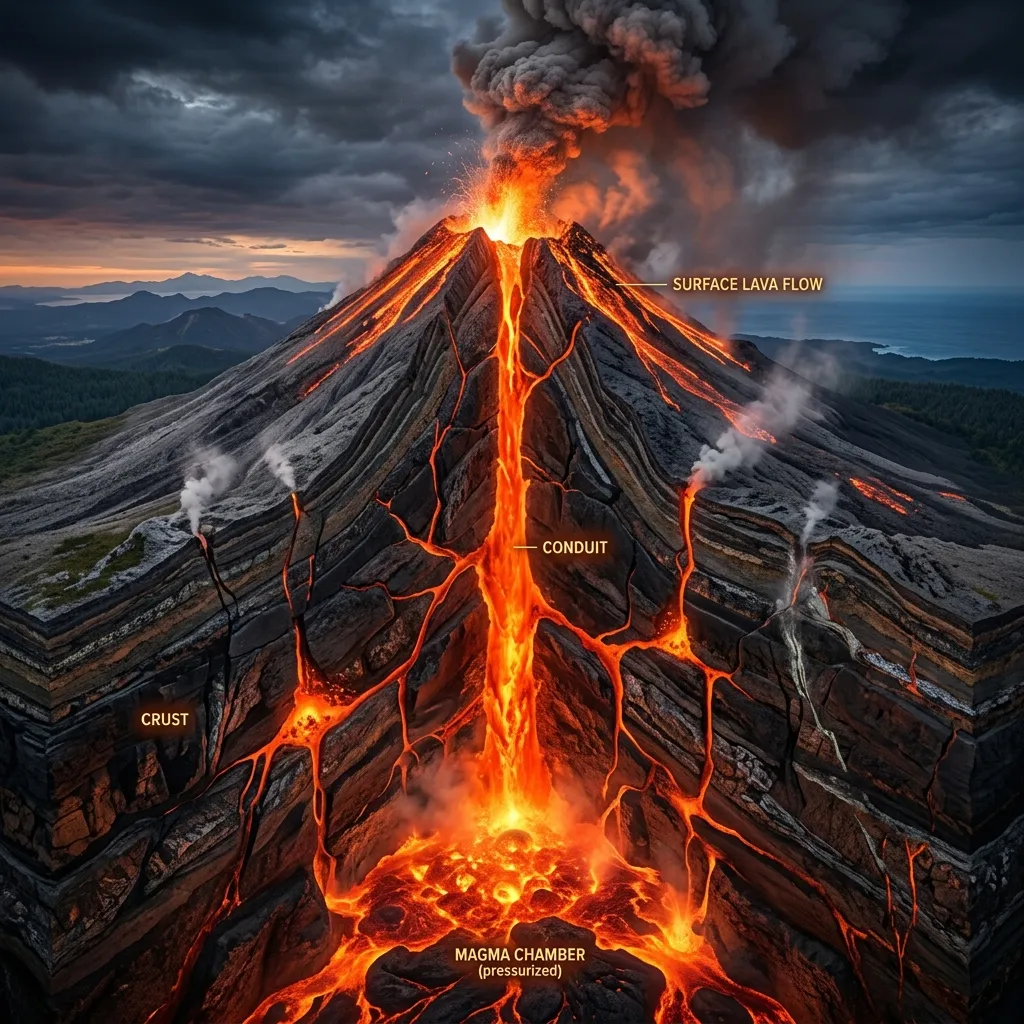
Deep beneath the cool, solid continental crust on which we build our cities lies Earth’s mantle—a 1,800-mile-thick layer of dense silicate rock under unimaginable heat and crushing gravitational pressure.
In specific hotspots and plate boundaries, temperatures soar high enough to melt this solid mantle into a bubbling, molten stew called magma.
Geologists strictly distinguish between two terms:
- Magma: Molten rock that is still trapped deep underground beneath the Earth's crust.
- Lava: Molten rock the exact second it breaches the surface and makes contact with open air or sea water.
The transition from magma to lava is dramatic. Underground, magma is packed with dissolved volcanic gases—primarily water vapor, carbon dioxide, and sulfur dioxide—kept dissolved by the intense pressure of miles of overlying rock.
As magma forces its way up through volcanic vents toward the surface, that pressure drops. Just like twisting the cap off a warm bottle of soda, the dissolved gases violently expand and bubble out of the rock, propelling the liquid skyward in towering fountains!
The Viscosity Secret: Honey vs. Peanut Butter
Why do some volcanoes (like Hawaii’s Kilauea) gently ooze peaceful glowing rivers, while others (like Mount St. Helens) violently blow their entire mountain tops off?
The secret comes down to a single chemical ingredient: silica ($SiO_2$).
- Low-Silica Basaltic Lava: Rich in iron and magnesium but low in silica, this lava has low viscosity (resistance to flow). It is thin and runny, flowing smoothly like hot molasses at speeds up to 30 miles per hour. Because gases can easily bubble out without getting trapped, these eruptions are relatively gentle, building wide, gently sloping shield volcanoes.
- High-Silica Rhyolitic Lava: Packed with dense silica chains, this lava is hyper-viscous—thick and sticky like cold peanut butter. It crawls sluggishly and forms tall, steep domes. Crucially, expanding gas bubbles cannot easily escape this thick paste. The pressure builds and builds until the rock shatters catastrophically in a colossal explosion of ash, pumice, and pyroclastic fury.
The World of Volcanic Textures
Geologists worldwide borrow two famous Hawaiian words to describe the two primary textures of cooled basaltic lava:
- Pāhoehoe (pah-HOY-hoy): Lava that flows smoothly, forming a flexible, glassy skin that wrinkles into ropes, braids, and smooth ripples as the molten interior continues to creep beneath.
- ‘A‘ā (AH-ah): Lava that has lost most of its heat and gas, tearing into a jagged, razor-sharp tangle of spiky volcanic clinkers. Walking across an ancient 'a'ā field with bare feet would shred your shoes in minutes!
Building Brand New Continents
Lava is not just a destructive force; it is the ultimate planetary creator. Every single island in the Hawaiian archipelago, the entire country of Iceland, and more than 70% of the Earth's oceanic crust was forged entirely by cooled lava.
When liquid lava meets the air or freezes under the ocean, it solidifies into igneous rock:
- Dense, black basalt that paves the ocean floor.
- Pitch-black, razor-sharp obsidian (natural volcanic glass formed when lava cools too quickly for mineral crystals to grow).
- Frothy pumice, a stone so riddled with trapped gas bubbles that it is the only rock on Earth that can actually float on water!
Fast Facts About Lava
- Glowing Blackbody Radiation: Lava’s orange glow is not caused by burning; it is blackbody radiation—the same physics that makes a hot stove coil or the filament in an incandescent light bulb glow when heated to high temperatures.
- Pillow Lava: When lava erupts deep on the ocean floor, the freezing water instantly freezes a glassy crust around it, forming bulbous, pillow-shaped mounds that stack like sandbags.
- Cold Black Lava: The Ol Doinyo Lengai volcano in Tanzania erupts bizarre, carbonatite lava made of sodium and potassium carbonates. It erupts at a relatively "chilly" 950°F (510°C) and flows black as motor oil during the day, glowing faint red only in total darkness!
Related Wonders
 Chemistry
Stomach Acid
Discover the powerful chemical furnace inside your body. Learn about the incredibly strong hydrochloric acid that can dissolve metal, and how your stomach's clever protective lining keeps it from digesting itself along with your lunch.
 Physics
How Do Batteries Store Energy?
Peek inside the metallic shell of a battery to discover the silent chemical war that powers our modern world. Learn how trapped ions and escaping electrons create the invisible force that fuels everything from your smartphone to electric cars.
 Earth
How Do Mountains Form?
Witness the slow-motion collision of continents and discover how the Earth's crust crumples like a massive car crash to build the world's highest peaks. Learn why you can find ocean seashells at the very top of Mount Everest.