
Why Are Snowflakes Six-Sided?
The Big Idea
Discover why every snowflake falls with exactly six sides. Learn how the microscopic atomic geometry of water molecules forces ice crystals to grow in perfect hexagonal patterns as they drift through the cold clouds.
Key Vocabulary & Concepts

Hands-On Observation Checklist
Teacher & Parent Discussion Starters
- Why is understanding why are snowflakes six-sided? important in everyday real life?
- What variable or factor had the biggest impact when testing the simulation?
- How does this concept connect to another science topic you have learned about?
Why Are Snowflakes Six-Sided?
The Six-Cornered Secret
Catch a snowflake on your winter glove. Look incredibly closely before it melts. If you are lucky, you will see a perfect, tiny ice star. But if you take a magnifying glass to that star, you will notice something specific and unyielding: It has exactly Six arms.
Not 5. Not 4. Not 7. It is always 6.
In the winter of 1611, the famous astronomer Johannes Kepler (the brilliant scientist who figured out how planets orbit the sun) was walking across a bridge in Prague. A snowflake landed on his dark coat. He looked at it. Then another landed. Then another. He realized, to his amazement, they were all perfectly hexagonal.
He wrote an entire book called The Six-Cornered Snowflake, trying to figure out why nature was so obsessed with the number six. He didn't have a microscope powerful enough to see the actual answer, but he guessed it had to do with how invisible water particles "stack" together. He was absolutely right.
A breathtaking extreme macro photograph of a perfect six-sided snowflake on a dark glove
The Atomic Lego
The answer to Kepler's mystery lies inside the Water Molecule itself (H2O).
Picture the classic "Mickey Mouse" shape of a water molecule: One large Oxygen atom as the head, and two smaller Hydrogen atoms as the ears. The angle between those two ears is strictly locked at roughly 104.5 degrees.
When water freezes into ice, these molecules slow down and have to lock hands together. Because of their specific "Mickey Mouse" shape and their electrical charge, the absolute most efficient way for them to hold hands is in a Hexagon. Exactly six water molecules link up to form a tiny, perfect ring with six sides.
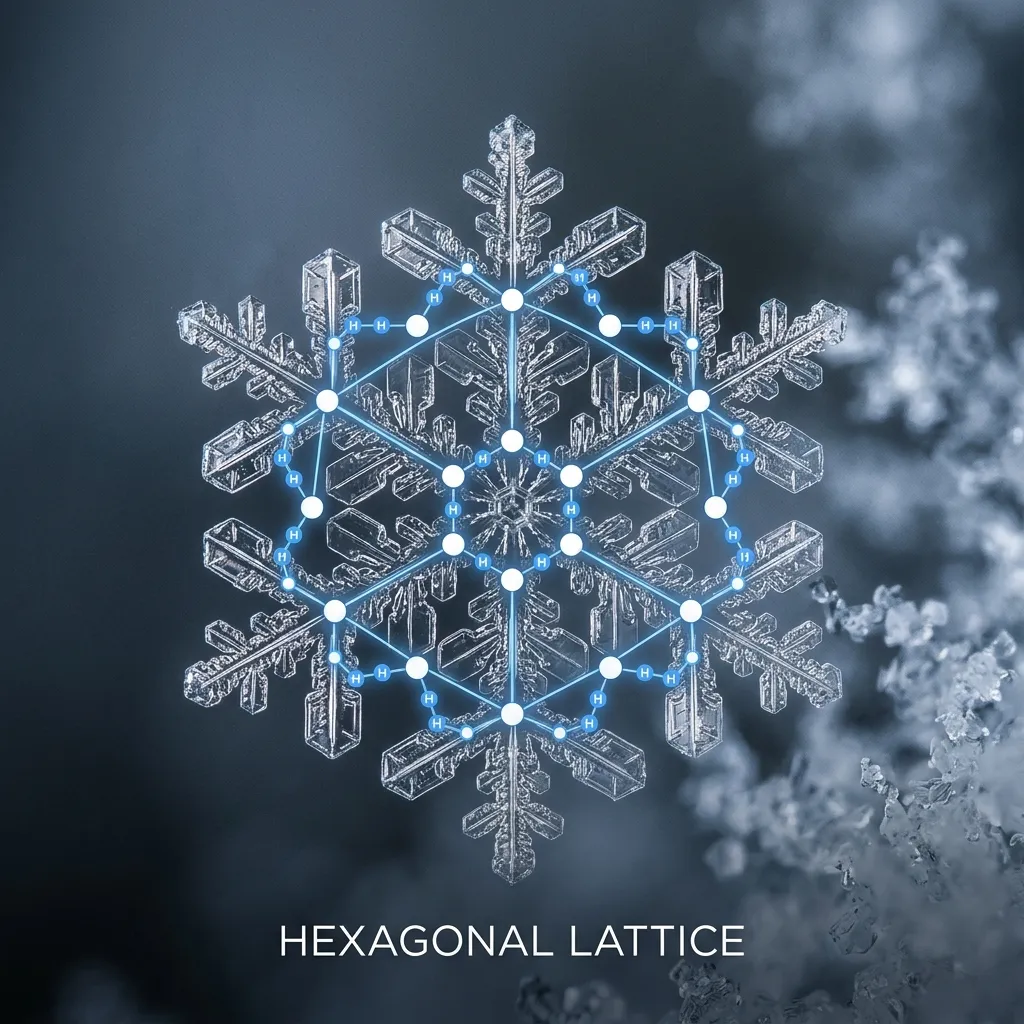 Hexagonal Lattice: The microscopic atomic arrangement of water molecules forming ice
This microscopic, invisible ring is the "Seed" of the snowflake. As the snowflake floats through the wet cloud, more water vapor freezes onto the seed. But because the foundation is a hexagon, the ice can only build outward from those six specific corners.
It grows six arms. If an arm grows a tiny sub-branch, that branch is forced to grow at a perfect 60-degree angle. The entire, beautiful architecture of the snowflake—miles of crystalline ice—is just a macro-scale projection of the invisible atomic geometry of water.
No Two Alike?
Is the old saying true? Are no two snowflakes exactly alike? Yes.
As the snowflake falls through the massive, chaotic storm cloud, it goes on an epic journey.
- Second 1: It hits a pocket of very cold, dry air. The arms grow long and thin like needles.
- Second 5: It tumbles into a pocket of warm, wet air. The arms suddenly grow wide, flat plates.
- Second 10: It spins violently in a gust of wind, causing one side to grow slightly faster than the other.
Every single second of its fall, the temperature and humidity change. These changes directly dictate how the ice crystal grows. Since every snowflake takes a completely unique, tumbling path from the top of the cloud to the ground, every snowflake records a unique history in its final shape.
It is a beautiful diary of its fall, written permanently in ice. The laws of physics strictly demand the six-sided hexagon, but the chaos of the winter wind ensures that the final masterpiece is entirely unique.