
Why Do Bees Make Hexagons?
The Big Idea
Step inside the hive to solve a mathematical mystery. Discover why honeybees chose the hexagon as their ultimate storage shape, and how it allows them to use the least amount of wax for the most amount of honey.
Key Vocabulary & Concepts
Hands-On Observation Checklist
Teacher & Parent Discussion Starters
- Why is understanding why do bees make hexagons? important in everyday real life?
- What variable or factor had the biggest impact when testing the simulation?
- How does this concept connect to another science topic you have learned about?
Why Do Bees Make Hexagons?
The Perfect Pantries
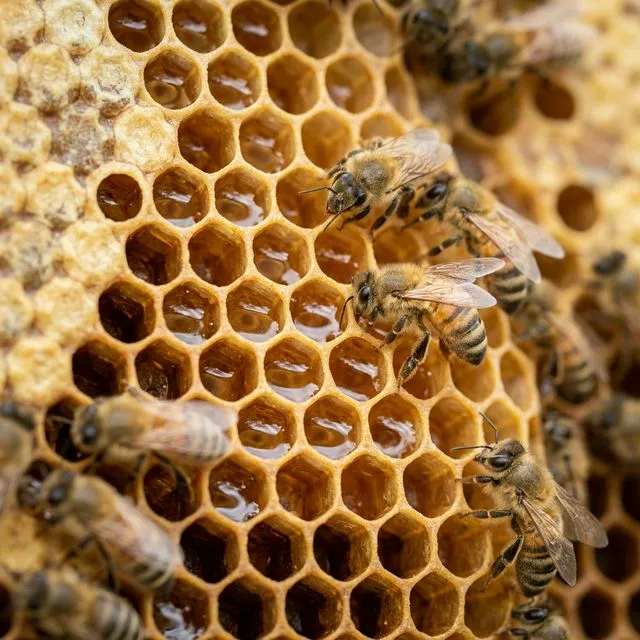
Open up a beehive, and you will see an engineering masterpiece. Thousands of tiny cells, identical in size, stacked in a perfect grid. Each one is a Hexagon (a six-sided shape).
Why? Why not squares? Why not triangles? Or circles?
Bees aren't just making art. They are solving a complex math problem that humans call "The Honeycomb Conjecture." They are trying to build the most efficient storage warehouse in the world, and the cost of construction is high.
The Cost of Wax
For bees, building material is expensive. To build the comb, they use Beeswax. But they can't just go out and buy wax. They have to make it. Young worker bees have special glands in their stomachs that convert sugar into tiny wax flakes.
It is a grueling process. To make just one ounce of wax, bees have to consume eight ounces of honey. That is a lot of flight hours, a lot of flower visits, and a lot of work.
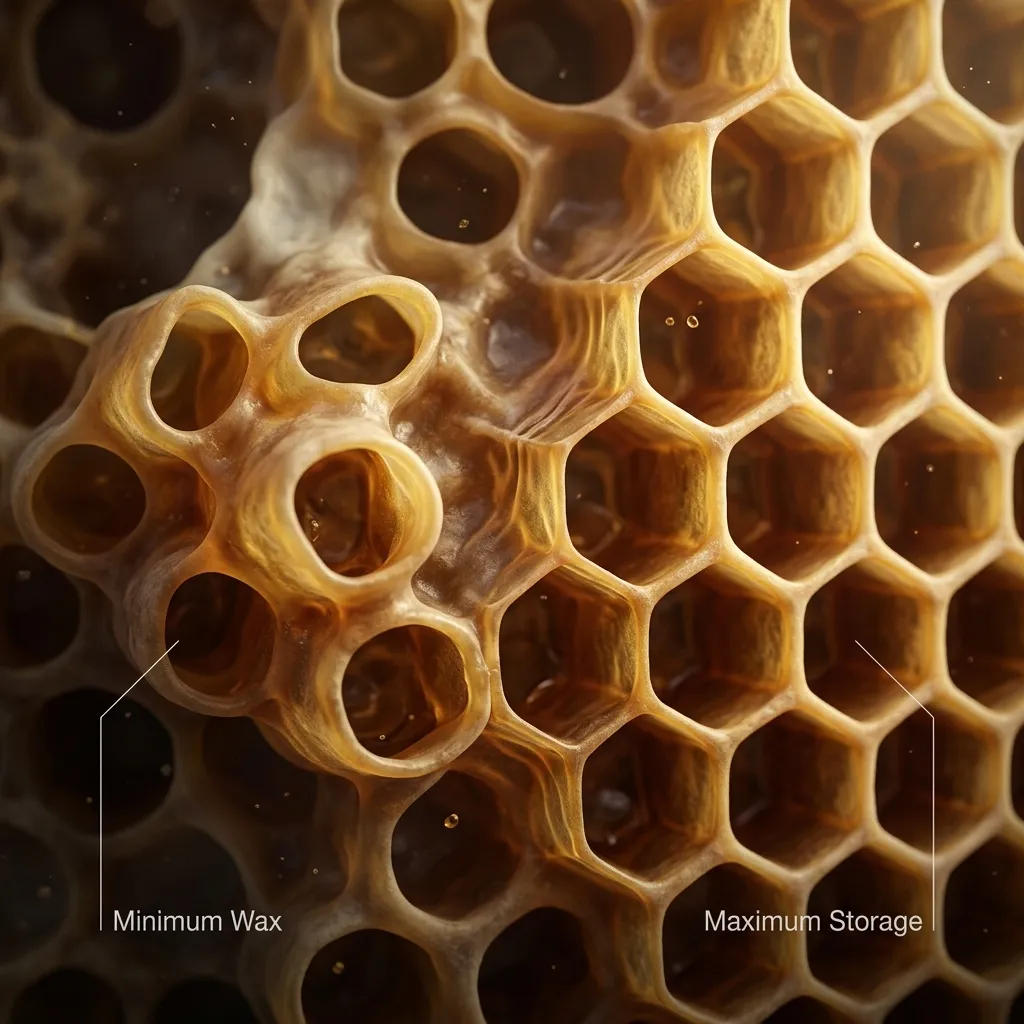
So, the goal is simple: Maximum Storage (for honey and babies) using Minimum Wax.
The Geometry Test
Let's look at the options for tiling a floor (or a hive) without leaving any wasted gaps.
- Circles: If you stack circles (like soda cans), you get wasted space in the corners. Gaps mean wasted room where honey could go.
- Triangles: These fit together perfectly with no gaps. But they have a lot of "wall" for very little "room" inside. Too much wax.
- Squares: Better than triangles, but still not great.
- Hexagons: The Champion.
Mathematical proof shows that of all the shapes in the geometry universe, the Hexagon has the highest Area-to-Perimeter ratio. It holds the most honey for the least amount of wall.
It is the most efficient structure in nature. Structural engineers use this shape today to build lightweight airplane wings and satellite walls. We call it "Honeycomb core." The bees figured it out millions of years before our best architects did.
The Secret: They Don't Build Hexagons
Here is the twist. Bees don't actually build hexagons. They build Circles.
If you watch bees building a new comb in slow motion (or usually X-ray video), you will see them working furiously to make round cylinders. They are like potters making tiny round clay pots.
So how do they become sharp-edged hexagons? Heat and Physics.
The hive is a busy, hot place. The friction of thousands of bees working heats the wax to about 45°C (113°F). At this specific temperature, beeswax becomes soft and elastic—like stretchy putty.
As the bees pack the round cells together, the walls touch. The surface tension of the cooling wax pulls the triple-junctions (where three walls meet) into a flat line. The soft circles physically snap into hexagons, just like a raft of bubbles in a bubble bath.
If you blow a layer of bubbles on water, they naturally form hexagons. The bees are using the laws of physics to do the hard work for them. They build round tubes, and nature snaps them into the perfect mathematical grid.
The Ancient Math
Humans debated this for centuries. In 36 BC, the Roman scholar Marcus Terentius Varro suspected that hexagons were the most efficient shape, but he couldn't prove it. It wasn't until 1999 (yes, really!) that a mathematician named Thomas Hales finally provided the mathematical proof for the "Honeycomb Conjecture."
It took humans 2,000 years of math to prove what the honeybee has known instinctively since the dawn of flower-time.