
Why Do Chameleons Change Color?
The Big Idea
Explore the vibrant world of chameleon biology. Discover how these masters of disguise use microscopic crystals in their skin to change color, and why they do it more for communication than camouflage.
Key Vocabulary & Concepts
Hands-On Observation Checklist
Teacher & Parent Discussion Starters
- Why is understanding why do chameleons change color? important in everyday real life?
- What variable or factor had the biggest impact when testing the simulation?
- How does this concept connect to another science topic you have learned about?
Why Do Chameleons Change Color?
The Spy Movie Myth
If you watch cartoons or spy movies, you probably think you know how chameleons work. The chameleon walks onto a chessboard? Zap. It turns a Checkerboard pattern. It walks onto a plaid shirt? Zap. It turns Plaid. It walks onto pink polka dots? Zap. Pink polka dots.
This is the great myth of the chameleon. It is a fantastic superpower, but unfortunately, it is totally false. Chameleons cannot copy intricate patterns, and they don't look at "what they are standing on" to decide their color.
If you put a chameleon on a chessboard, it won't turn checked. It will just look like a very confused (and probably green) lizard standing on a chessboard.
So, if they aren't trying to disappear, what are they doing?
The Mood Ring of the Jumping
Chameleons don't use color for stealth. They use it for Communication. They are living, breathing mood rings.
Imagine if your face turned bright purple every time you were angry, or neon green every time you relaxed. You wouldn't be able to keep a secret. That is life for a chameleon.
The color change is a social signal to other lizards.
- "I am Calm": A relaxed chameleon is usually a dull green or brown. This helps it blend in with leaves (passive camouflage), but it's just its default "pajama" mode.
- "Back Off!": When two males fight over territory, they don't just wrestle. They have a color battle. They turn bright, aggressive colors—reds, oranges, and yellows. The brighter the color, the more dominant the male. It is a way of shouting, "Look how strong I am!"
- "I'm Single": Females use color to signal if they are interested in a mate or if they want to be left alone.
They also use color for Thermoregulation (temperature control). Lizards are cold-blooded. They need the sun to warm up.
- Too Cold: They turn dark (black/brown). Dark colors absorb heat (think of wearing a black shirt on a sunny day).
- Too Hot: They turn pale (mint green/grey). Light colors reflect heat.
The Nanocrystal Physics
For a long time, scientists thought chameleons changed color by moving pigments around—like squeezing tubes of yellow or red paint under their skin.
But in 2015, scientists discovered the truth, and it is far more sci-fi. Chameleons don't paint themselves. They use Nanotechnology.
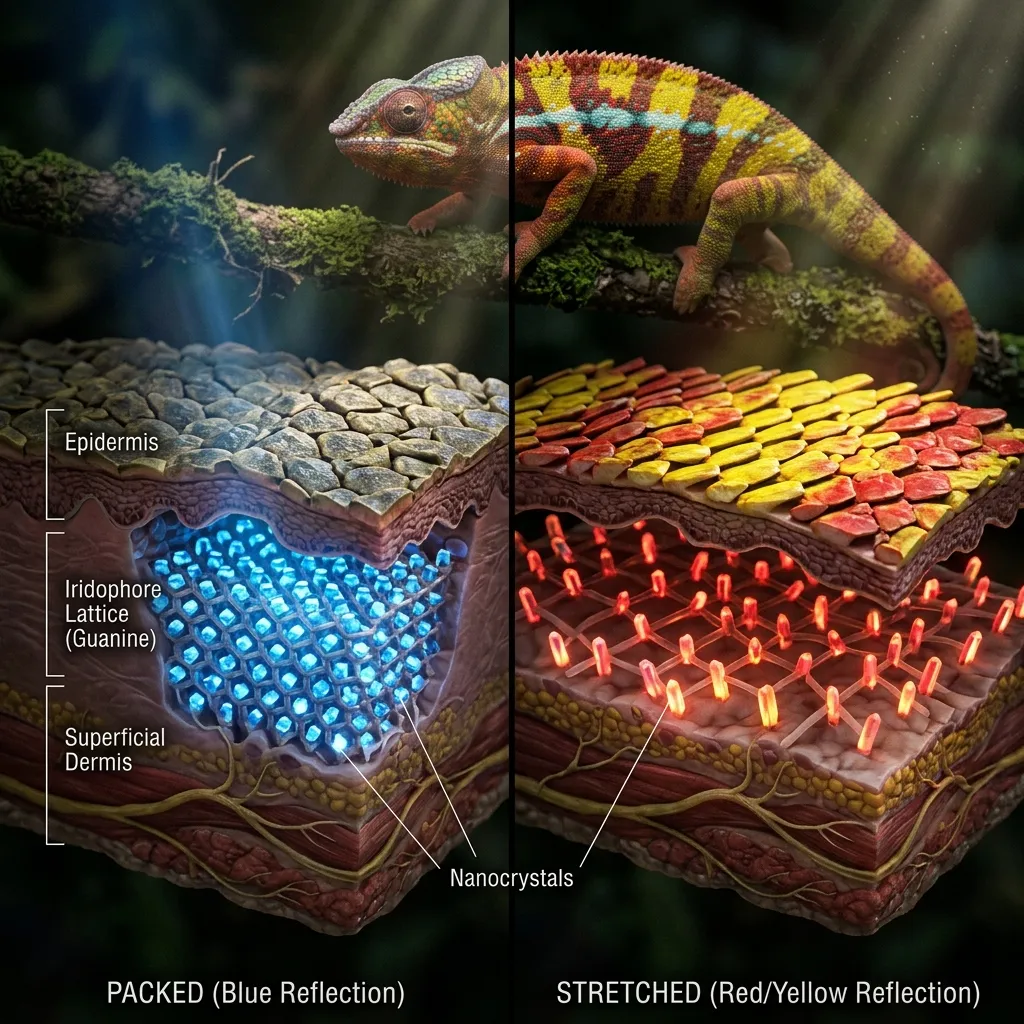
Underneath a chameleon's skin, there is a layer of special cells called Iridophores. These cells don't contain colored dye. Instead, they contain tiny microscopic crystals made of guanine (a DNA building block).
These crystals are arranged in a perfect lattice grid. They act like tiny mirrors that reflect light. The spacing of the crystals determines which color is reflected.
- Relaxed Skin: The crystals are packed tight together. They reflect short wavelengths of light, like Blue. (The blue light travels through the yellow skin pigment above it, making the lizard look Green).
- Excited Skin: When the chameleon gets excited or angry, it stretches its skin cells. The lattice of crystals expands. The gaps get bigger. Now, instead of reflecting blue, they reflect longer wavelengths like Yellow, Orange, or Red.
So the chameleon isn't "dyeing" its skin. It is physically tuning the geometry of its skin cells to bounce different parts of the rainbow. It is manipulating the physics of light with its mind.
Comparison: It’s exactly like tuning a guitar string. Stretch it tight vs. let it loose, and you get a different note. The chameleon stretches its crystals, and you get a different color.
Dealing with the Truth
So, chameleons are not the master spies of the animal kingdom. They are actually loud, emotional exhibitionists who wear their hearts on their skin.
But isn't that cooler? A lizard that turns on a light show to scream at its rivals using nanocrystal physics is surely more interesting than one that just hides on a plaid shirt.