
Why Do We Blink?
The Big Idea
Discover the ingenious biological windshield wipers that protect your vision. Learn how blinking keeps your eyes clean and moist, while granting your hardworking brain thousands of tiny mental breaks throughout the day.
Key Vocabulary & Concepts

Hands-On Observation Checklist
Teacher & Parent Discussion Starters
- Why is understanding why do we blink? important in everyday real life?
- What variable or factor had the biggest impact when testing the simulation?
- How does this concept connect to another science topic you have learned about?
Why Do We Blink?
Discover the ingenious biological windshield wipers that protect your vision. Learn how blinking keeps your eyes clean and moist, while granting your hardworking brain thousands of tiny mental breaks throughout the day.
Why Do We Blink?
The Biological Windshield Wipers
Imagine driving a fast sports car down an incredibly dry, dusty dirt road. If you stubbornly never used the windshield wipers, the front glass would quickly become completely coated in a thick, gritty layer of dirt and dead bugs, making it totally impossible to safely see the road ahead. Your incredibly fragile eyes face the exact same physical problem every single day.
The primary, physical reason we continuously blink is to flawlessly clean and perfectly lubricate the delicate, exposed surface of the human eye (the cornea). Each time you shut your thin, fast-moving eyelids, tiny anatomical Tear Glands securely located just above your eye forcefully release incredibly thin layers of specialized, salty tears. Your moving eyelids then aggressively wipe this moisture completely across the exposed cornea, acting exactly like biological windshield wipers.
A breathtaking extreme macro photograph of a beautiful human eye in the middle of a blink, showing delicate eyelashes
This rapid, incredibly precise wiping motion safely removes tiny drifting particles of dust, dead skin, and dangerous microscopic bacteria before they can scratch or infect the sensitive eye.
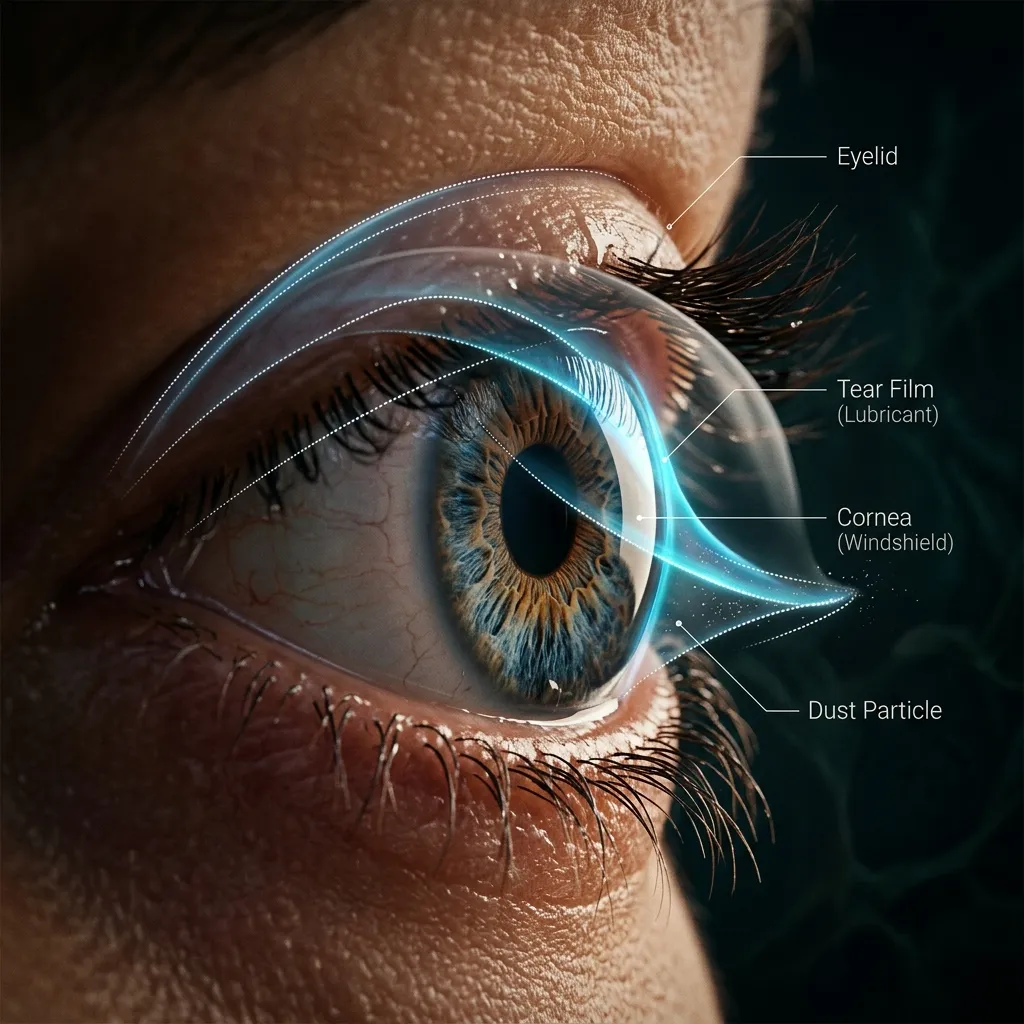 An elegant scientific diagram illustrating the 'Windshield Wiper' metaphor, comparing the eyelid's sweeping motion to a car's wiper
The Mental Micro-Break
This cleaning process is absolutely vital for physical survival. However, neuroscientists have recently discovered a secondary, purely psychological reason for our continuous, rapid-fire blinking.
An average, healthy human unconsciously blinks nearly 15,000 to 20,000 times a single day. If you mathematically calculate the lost visual time from all those split-second flashes of darkness, it turns out we spend roughly 10% of our waking daylight hours with our eyes completely shut!
If you are awake for 16 hours, you spend over 1.5 of those hours effectively blind. But why don't we ever notice the world violently flashing black 15,000 times a day? Because the brain actively suppresses our visual processing during the blink, seamlessly stitching the video feed together so we never notice the missing frames.
Instead of missing important visual information, researchers discovered that the human brain strategically uses these exact split-second moments of total darkness to briefly disengage from active focus. A single rapid blink serves as a tiny, vital mental reset button, allowing the heavily overworked brain to quickly gather itself before aggressively absorbing the next massive wave of intense visual information.
 An elegant schematic diagram illustrating the 'Neural Reset', showing the brain's activity dipping during a blink