
Why Do We Have Leap Years?
The Big Idea
Unlock the cosmic math behind our calendar. Discover why we need an extra day every four years to keep our clocks in sync with the Earth's 365.25-day journey around the Sun.
Key Vocabulary & Concepts

Hands-On Observation Checklist
Teacher & Parent Discussion Starters
- Why is understanding why do we have leap years? important in everyday real life?
- What variable or factor had the biggest impact when testing the simulation?
- How does this concept connect to another science topic you have learned about?
Why Do We Have Leap Years?
The Massive Calendar Problem
We are strictly taught from a very young age that a standard, reliable year clearly has exactly 365 complete days. Unfortunately, that comforting astronomical "fact" is completely false.
A "year" is scientifically and strictly defined as the exact physical amount of time it fully takes the massive planet Earth to successfully complete one single, massive orbital lap entirely around the hot Sun. The enormous problem that ancient calendar makers slowly discovered is that the Earth simply doesn't move perfectly in sync with our convenient 24-hour daily spin.
It actually physically takes the Earth exactly 365.24219 days to completely finish the giant lap. We are dealing with pesky, stubborn fractions of a spinning day!
The Aggressive Drift
Because society universally agrees that we absolutely do not want a brand new "year" to officially start at precisely 6:00 AM on a random Tuesday, we purposely decided to chop off the extra quarter of a day (roughly 6 hours) entirely off our calendars and pretend it doesn't exist.
But if we just permanently ignore those 6 leftover hours every single year, our human calendar slowly predictably drifts completely out of sync with the physical reality of the solar system. After a mere 100 years strictly without leap years, our printed calendar would be off by 25 full days. Eventually, the hot summer season in the Northern Hemisphere would officially incredibly start in the dark, dead, freezing middle of December!
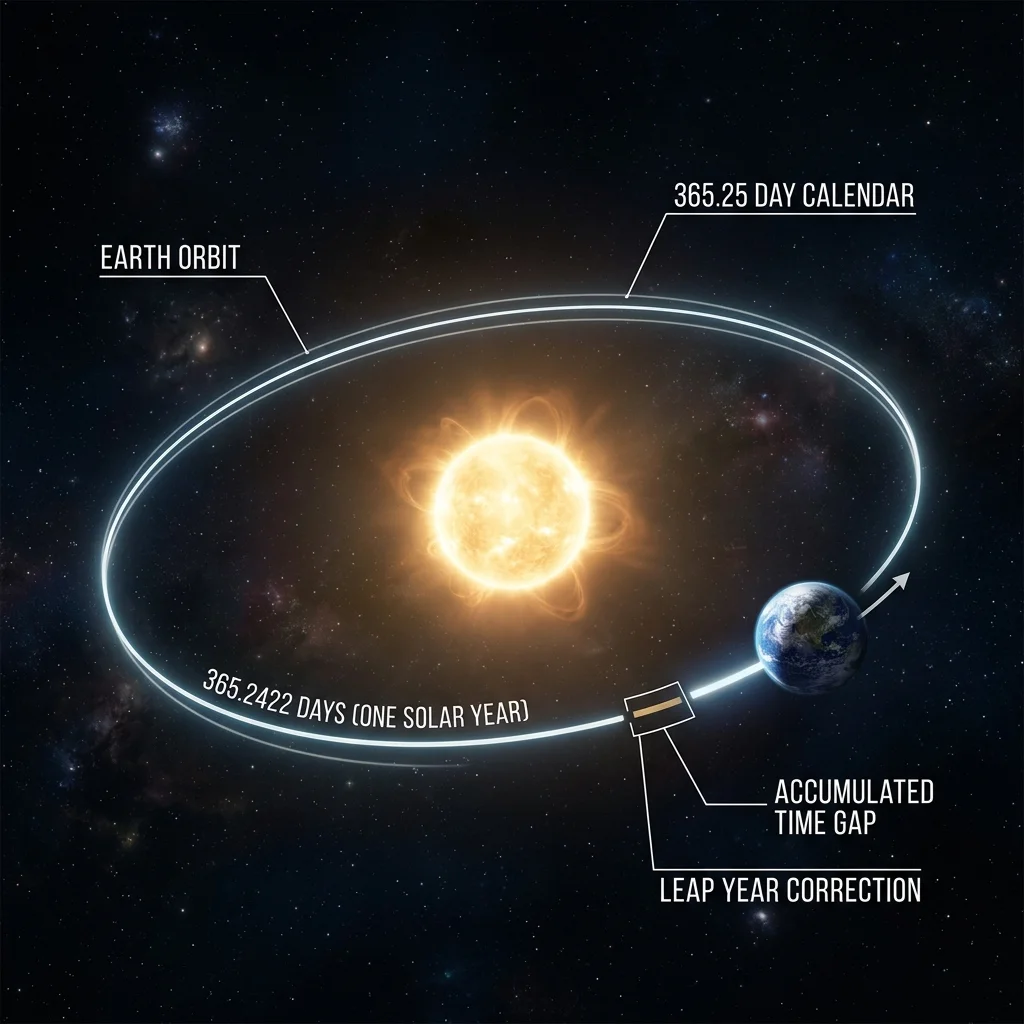
To perfectly fix the complex math and securely keep the vital seasons firmly locked in place, we carefully save up those tiny leftover quarter-days for exactly four years. We then neatly piece four quarters firmly together into one brand new, full 24-hour day, and safely stick it directly onto the very end of the shortest month, giving us February 29th!