
Why Do We Sweat?
The Big Idea
Discover the incredible biological cooling system that prevents your body from overheating. Learn how thousands of sweat glands release water to carry heat away from your skin, allowing you to thrive in the summer sun.
Key Vocabulary & Concepts
Hands-On Observation Checklist
Teacher & Parent Discussion Starters
- Why is understanding why do we sweat? important in everyday real life?
- What variable or factor had the biggest impact when testing the simulation?
- How does this concept connect to another science topic you have learned about?
Why Do We Sweat?
Discover the incredible biological cooling system that prevents your body from overheating. Learn how thousands of sweat glands release water to carry heat away from your skin, allowing you to thrive in the summer sun.
Why Do We Sweat?
A cheetah can sprint across the African savanna at a breathtaking 70 miles per hour, but it can only sustain that blistering speed for roughly thirty seconds before its brain begins to dangerously overheat, forcing it to stop and rest.
A human, by contrast, cannot outrun a cheetah in a sprint. Yet on a hot summer afternoon, a trained human athlete can run twenty-six miles without stopping.
How can our relatively slow, hairless species accomplish feats of endurance that collapse the fastest predators on Earth? The secret is our biological superpower: an evolutionary radiator system made of two to four million microscopic sweat glands embedded in our skin.
The Body's Master Thermostat
Humans are warm-blooded endotherms. Our complex cellular machinery is calibrated to operate within a narrow temperature window centered right at 98.6°F (37°C).
If your core body temperature rises just a few degrees—whether from playing soccer, running a fever, or standing under the midday sun—the enzymes that keep your cells alive begin to break down, risking deadly heatstroke.
Deep inside your brain sits the hypothalamus, your body’s master thermostat.
When temperature-sensitive neurons in the hypothalamus detect heated blood arriving from your core, they instantly sound the alarm. They fire nerve signals through your sympathetic nervous system, ordering blood vessels near your skin surface to dilate and commanding millions of sweat glands to open the floodgates.
The Physics of Evaporation: Stealing Heat
A widespread misconception is that simply being wet is what cools you down. Pouring lukewarm water over your arm does very little on its own.
The true magic relies on a law of thermodynamics known as the latent heat of vaporization.
Water molecules are held together by relatively strong hydrogen bonds. Converting one gram of liquid sweat into an invisible water vapor gas requires an immense amount of thermal kinetic energy—roughly 2,260 joules of heat.
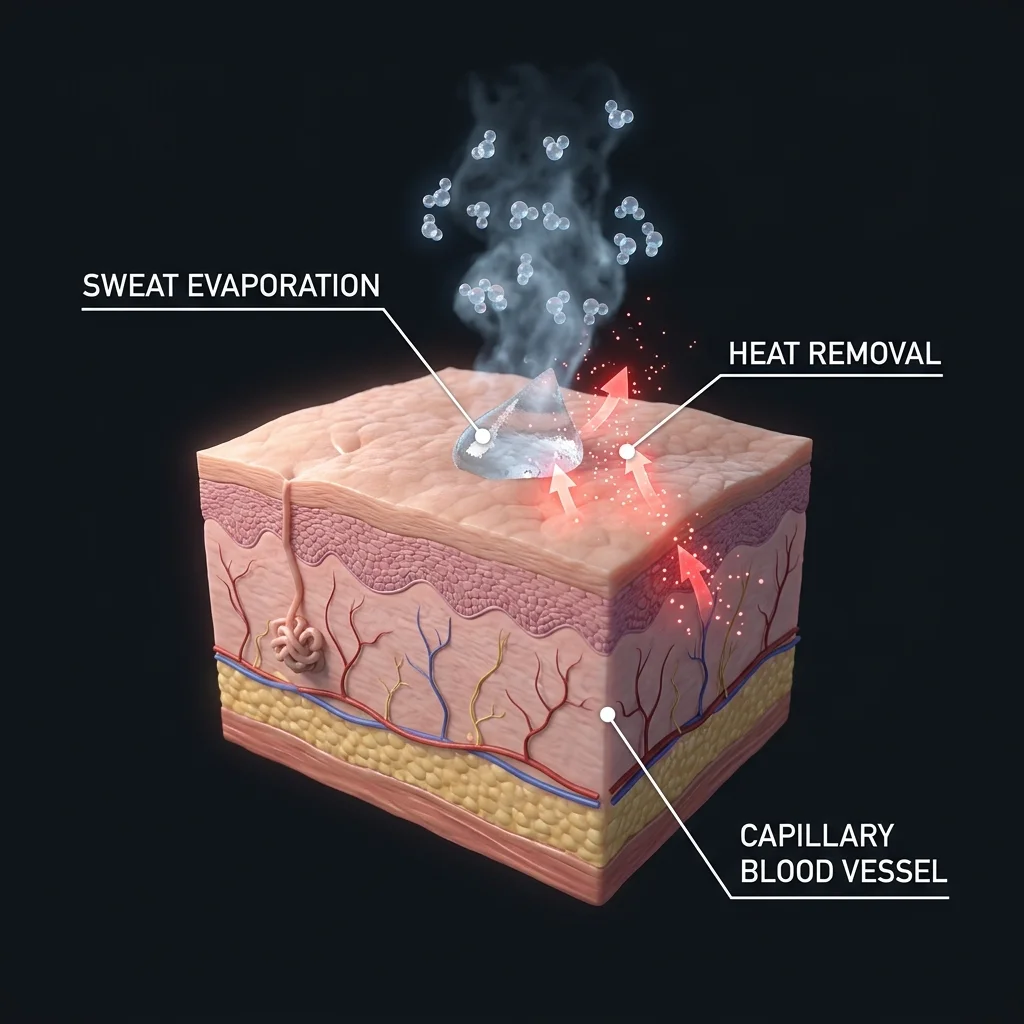
As a thin film of sweat coats your warm skin, the fastest, hottest water molecules absorb heat energy directly from your superficial blood vessels. Once they gain enough energy, they break free and evaporate into the air.
As the energetic molecules escape, the average temperature of the remaining liquid drops. The cooled skin immediately chills the blood rushing through nearby capillaries, which then circulates back into your body to cool your vital organs!
Two Types of Sweat Glands
Not all sweat is created equal. Your skin hosts two distinct varieties of sweat factories:
- Eccrine Glands (The Coolers): Found virtually everywhere across your body—especially dense on your palms, soles, and forehead. They secrete a clear, odorless fluid that is 99% pure water with tiny traces of salt, potassium, and lactic acid. Their sole mission is temperature control.
- Apocrine Glands (The Stress Responders): Located primarily in your armpits and groin, these glands connect to hair follicles and activate during puberty. They secrete a thicker, milky fluid rich in lipids and proteins, triggered by emotional stress, anxiety, or adrenaline surges.
Why Does Sweat Smell?
Fresh human sweat—even from a grueling workout—is completely sterile and 100% odorless.
The pungent body odor commonly associated with sweaty gym clothes is caused by microscopic hitchhikers. Millions of harmless bacteria (primarily Corynebacteria) live naturally on your skin.
When your apocrine glands release their protein-rich secretions, these hungry bacteria feast on the fats and proteins, breaking them down into volatile, sulfur-rich chemical compounds called thioalcohols. That characteristic locker-room smell is not your sweat; it is bacterial digestion!
Fast Facts About Sweating
- Extreme Output: During intense exercise in hot conditions, a human can sweat up to three liters of water per hour! That is why drinking water and electrolytes is critical to avoid dehydration.
- Why Humidity Feels Miserable: In dry desert air, sweat evaporates almost instantly, cooling you efficiently. But in high humidity, the surrounding air is already saturated with water vapor. Sweat cannot evaporate into wet air; it simply drips uselessly off your forehead, leaving you hot, sticky, and exhausted.
- Panting Animals: Most mammals (like dogs and cats) have very few sweat glands. To cool down, they must pant, evaporating water from their tongue and lungs.
- Sweaty Palms: Sweating on your palms and soles when you are nervous is an ancient fight-or-flight reflex: slight moisture improved our ancestors' grip when climbing trees or grasping tools in life-or-death situations!
Related Wonders
 Human
Why Do We Sneeze?
Discover the violent, 100-mph biological explosion your body uses to protect your lungs. Learn how your brain triggers this high-speed air blast to aggressively eject microscopic invaders and dust from your sensitive airways.
 Human
How Do We Taste Food?
Discover the powerful chemical sensors living on your tongue. Learn how thousands of tiny taste buds work with your sense of smell to decode the flavors of your favorite foods and protect you from danger.
 Human
How Does The Heart Pump Blood?
Step inside the unstoppable biological engine that beats 100,000 times a day without ever resting. Discover how the heart’s four chambers and electrical signals work together to pump life-saving oxygen to every corner of your body.