
Why Don't We Float Away?
The Big Idea
Explore the invisible force of gravity that holds our world together. Discover how the Earth’s massive size creates a powerful pull that keeps us, our oceans, and our atmosphere firmly on the ground.
Key Vocabulary & Concepts
Hands-On Observation Checklist
Teacher & Parent Discussion Starters
- Why is understanding why don't we float away? important in everyday real life?
- What variable or factor had the biggest impact when testing the simulation?
- How does this concept connect to another science topic you have learned about?
Why Don't We Float Away?
The Invisible Tether
Jump. Go ahead, put this phone down and jump in the air. You went up, and then, instantly, you came back down. You didn't keep going. You didn't drift off into the clouds. Something grabbed you and pulled you back to the carpet.
We take this for granted, but it is actually very strange. We are spinning on a ball of rock at 1,000 miles per hour, orbiting the sun at 67,000 miles per hour. Yet we stick to the surface like glue.
This invisible glue is Gravity.
The Universal Attraction
For a long time, Isaac Newton thought of gravity as a "force"—like an invisible rubber band connecting every object in the universe. His law was simple: Mass attracts Mass. Everything with "stuff" in it pulls on everything else with "stuff" in it.
- You are pulling on the Earth.
- The Earth is pulling on you.
- Your coffee cup is pulling on your laptop.
But the strength of the pull depends on Mass (how heavy it is) and Distance. Your coffee cup is too small to move your laptop. But the Earth? The Earth is huge. It weighs 6,000,000,000,000,000,000,000 tons. Its pull is massive. You don't float away because this gargantuan ball of iron and rock is holding onto you with an iron grip.
The Trampoline of Space
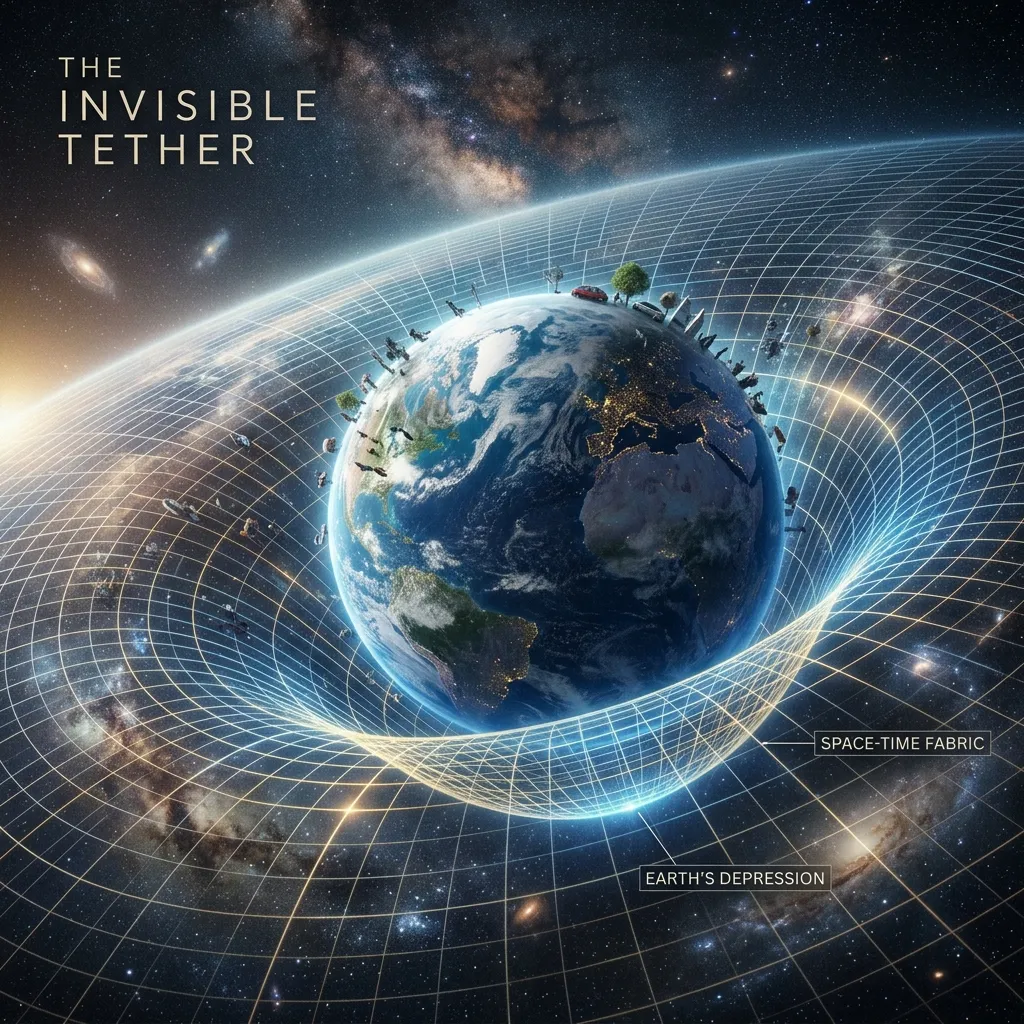
In 1915, Albert Einstein changed the picture. He said Newton was wrong. Gravity isn't a force or a rubber band. Gravity is Geometry.
Imagine a trampoline. The fabric is flat. Now, place a heavy bowling ball (The Sun) in the middle. The fabric curves down. Now, roll a marble (The Earth) across the trampoline. It doesn't go in a straight line. It follows the curve. It orbits the bowling ball.
Einstein said space itself is like that fabric. Massive objects like Earth bend the space around them. When you jump, you aren't being "pulled" down. You are sliding down the curve that Earth has made in the fabric of space-time. You are falling toward the center of the depression.
Ideally Weak
Here is a fun paradox: Gravity dominates the universe. It holds galaxies together. It crushes stars into black holes. But it is actually surprisingly weak.
Think about a tiny kitchen magnet. If you put a paperclip on the floor, the entire Earth is pulling down on it with all its mass. But if you hold that tiny magnet over it, the paperclip snaps up. A magnet the size of a coin can defeat the gravity of an entire planet.
This weakness is lucky for us. If gravity were much stronger, we would be crushed by our own weight. We wouldn't be able to stand up. Blood wouldn't be able to pump up to our brains. Instead, we live in the Goldilocks zone. Gravity is strong enough to keep our atmosphere from floating into space (so we can breathe), but weak enough that we can jump, run, and fly planes.
Escaping the Grip
Can you escape? Yes. But you have to go fast. To break free from Earth's gravity well, you need to reach Escape Velocity. That is about 25,000 miles per hour (Mach 33). If you can run that fast, you can jump off the Earth and never come back. Until then, you are stuck here with the rest of us.