
Why Is The Ocean Blue?
The Big Idea
Uncover the scientific reality behind the ocean's deep blue hue. Discover how water molecules absorb red light and scatter blue, creating the vibrant color we see in everything from a glass of water to the deep abyss.
Key Vocabulary & Concepts
Hands-On Observation Checklist
Teacher & Parent Discussion Starters
- Why is understanding why is the ocean blue? important in everyday real life?
- What variable or factor had the biggest impact when testing the simulation?
- How does this concept connect to another science topic you have learned about?
Why Is The Ocean Blue?
If you scoop a glass of water from the Atlantic Ocean, hold it up to a sunny window, and look closely, it is completely clear, transparent, and colorless.
Yet when astronauts look down at Earth from the International Space Station, our world is a magnificent, glowing sapphire marble.
A widespread myth claims that the ocean is blue simply because it acts as a giant mirror reflecting the blue sky. While calm water does reflect the sky right at the surface, that is not the real reason. Even on a gloomy, overcast day beneath thick gray storm clouds, the open sea remains distinctly deep navy blue.
And if you dive fifty feet beneath the waves wearing scuba goggles, you are enveloped in a surreal world of pure, luminous blue.
Water is not clear; water is intrinsically blue. But why does it take an ocean to see it?
The Selective Appetite of Water Molecules
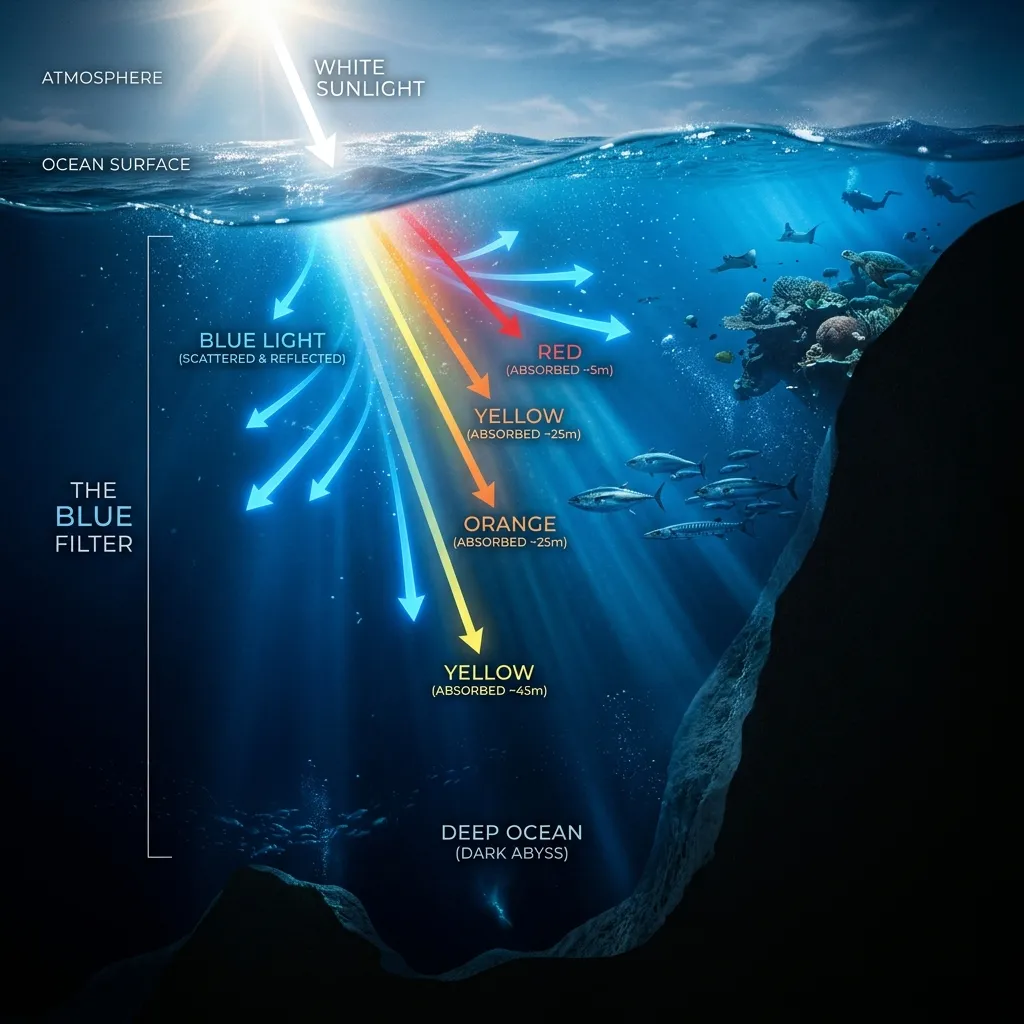
White sunlight from the Sun is not a single color. It is a rainbow mixture of every color in the visible spectrum—ranging from long, low-energy red wavelengths to short, high-energy violet and blue wavelengths.
When sunlight enters the ocean, water molecules ($H_2O$) act as a powerful optical filter.
Water molecules possess a natural vibrational frequency. The chemical bonds connecting hydrogen and oxygen atoms naturally stretch and bend in resonance with longer wavelengths of light: infrared, red, orange, and yellow.
As sunlight plunges downward, the water rapidly absorbs the red and orange photons:
- In the first 30 feet (10 meters) of water, nearly 100% of all red light is absorbed and converted into subtle heat.
- By 100 feet (30 meters), all yellow and orange light has been completely extinguished.
- By 300 feet (100 meters), even green light begins to fade away.
However, high-energy blue light travels in short, punchy waves. Because blue wavelengths do not resonate with water molecules, they pass through with very little absorption, penetrating up to 650 feet (200 meters) deep into the ocean's sunlit photic zone.
As these surviving blue photons travel through the water column, they collide with water molecules and bounce off in every direction—a physical process called Rayleigh scattering. Millions of scattered blue photons bounce back up through the surface and strike your eyes, giving the ocean its iconic sapphire hue!
The Scuba Diver's Blood Illusion
Because water strips red light so quickly, the deep ocean plays bizarre optical tricks on human perception.
If a scuba diver accidentally scratches their finger on a piece of coral at a depth of sixty feet, something eerie happens: their blood does not look red.
Because every single ray of red light was absorbed forty feet above them, there are zero red wavelengths available to bounce off the hemoglobin. Instead, the diver watches in shock as their blood oozes into the water looking like dark greenish-black or deep blue ink!
Once the diver swims back to the surface, the blood instantly returns to bright crimson as red sunlight strikes it again.
This is also why many deep-sea animals—like the giant squid, crimson jellyfish, and deepwater shrimp—are colored bright neon red. In the deep sea where red light cannot reach, having red skin is equivalent to wearing an invisibility cloak, rendering them pitch-black to predators!
Why Are Some Waters Turquoise or Emerald Green?
If water naturally absorbs red and scatters blue, why do some coastal waters and tropical lagoons look emerald green or milky turquoise?
- Phytoplankton (Green Water): Coastal waters are often packed with trillions of microscopic plant-like algae called phytoplankton. Phytoplankton use chlorophyll to photosynthesize, which absorbs blue light and reflects green light, tinting the sea like liquid jade.
- Glacial Flour (Turquoise Lakes): In glacial mountain lakes, grinding glaciers crush rock into a fine powder called "glacial flour." Suspended in the freezing water, this microscopic silt scatters green and blue-green wavelengths, creating brilliant milky turquoise pools.
- Tropical Lagoons: In places like the Bahamas or the Caribbean, shallow waters sit on beds of brilliant white limestone sand. The white sand reflects all surviving sunlight right back through the thin layer of water, producing glowing aqua-cyan shallows.
Fast Facts About Ocean Colors
- The Midnight Zone: Below 660 feet (200 meters), even blue light is completely extinguished. The deep ocean plunges into total, perpetual darkness where the only light is produced by bioluminescent creatures!
- Swimming Pool Effect: Have you ever noticed that large indoor swimming pools look pale blue even when filled with filtered city tap water and white tiles? That is pure water's intrinsic blue color revealing itself in volume!
- Satellites Measure Plankton by Color: NASA satellites monitor the health of global fisheries and climate change simply by tracking subtle color shifts in the oceans from space—greener oceans mean flourishing phytoplankton blooms producing oxygen.
Related Wonders
 Earth
What Causes Lightning?
Discover the violent atmospheric physics that turn storm clouds into giant floating batteries. Learn how ice and sleet crashing together generate massive sparks of natural static electricity that can heat the air to 50,000 degrees.
 Earth
What Is Color?
Unlock the secrets of the visible spectrum. Discover how different wavelengths of light and the biology of your eyes work together to create the vibrant world of color that you see every day.
 Earth
The Mariana Trench
Journey to the deepest point on Earth. Explore the Mariana Trench, a place of crushing pressure and eternal darkness where mysterious, bioluminescent creatures have adapted to survive in one of nature's most extreme environments.