
Why Is The Sun Hot?
The Big Idea
Uncover the terrifying power of nuclear fusion. Discover how the Sun’s massive core crushes hydrogen atoms together to create helium, releasing the enormous amounts of heat and light that power all life on Earth.
Key Vocabulary & Concepts
Hands-On Observation Checklist
Teacher & Parent Discussion Starters
- Why is understanding why is the sun hot? important in everyday real life?
- What variable or factor had the biggest impact when testing the simulation?
- How does this concept connect to another science topic you have learned about?
Why Is The Sun Hot?
The Cosmic Engine
The Sun is the absolute center of our world, a massive, glowing ball of light that provides every single ounce of energy needed for life on Earth. But have you ever stopped to think about how a giant ball of gas can stay incredibly hot for billions of years without ever burning out?
If you tried to build a campfire in the cold, dark vacuum of space, it would instantly fail because fire requires oxygen to breathe. There is no oxygen in space. The Sun isn't "burning" like a piece of wood or a giant puddle of gasoline. It is doing something infinitely more powerful and terrifying: Nuclear Fusion.
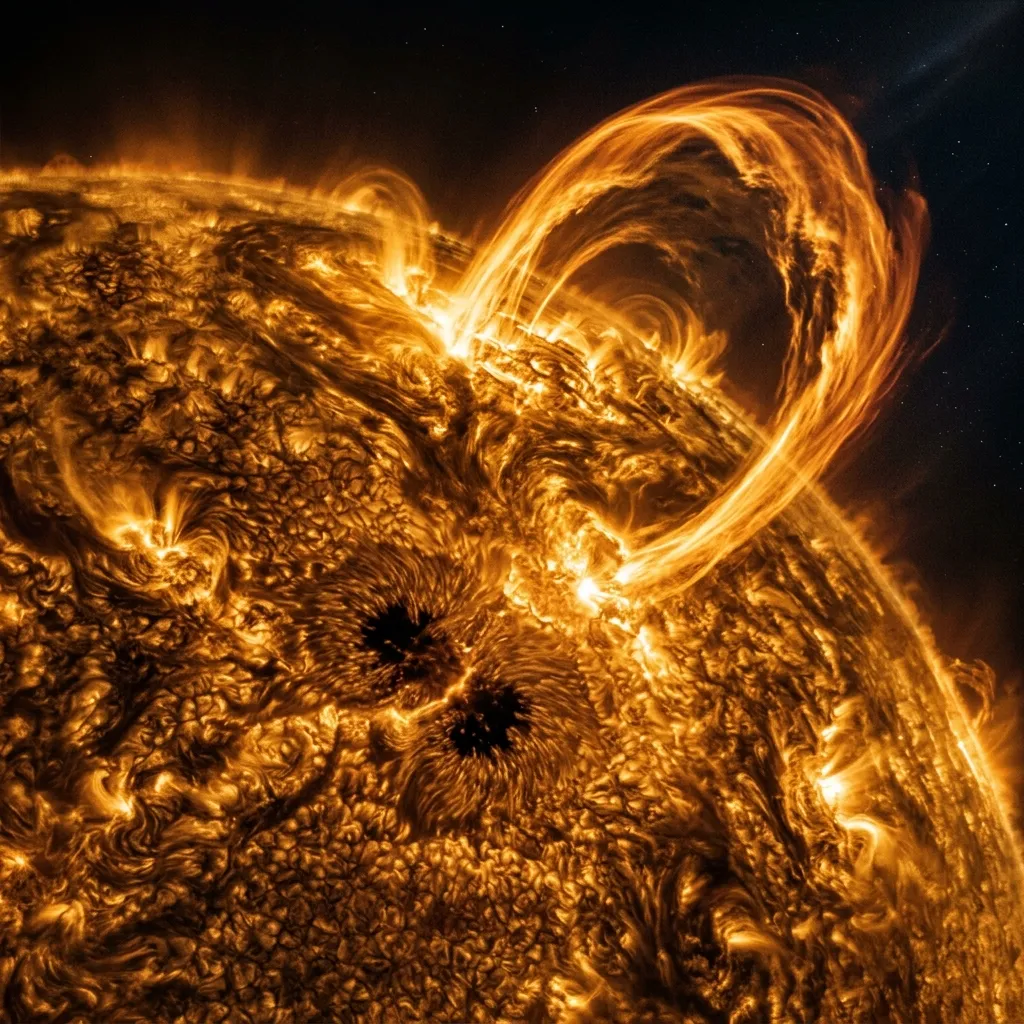
A breathtaking cinematic photograph of the Sun's surface showing massive solar flares and orange plasma
Crushing Atoms
The Sun is so unfathomably massive that its own gravity is constantly trying to crush it into a tiny, microscopic point. This intense pressure at the Sun's center (the core) is so extreme that it heats the gas up to an absolutely mind-blowing 27 million degrees Fahrenheit.
In this brutal environment, the rules of normal chemistry completely break down. The Sun is mostly made of Hydrogen, the simplest and lightest element in the universe. Normally, hydrogen atoms like to keep their distance from each other. But deep inside the Sun, the crushing weight of gravity forces them together with such violence that they physically merge.
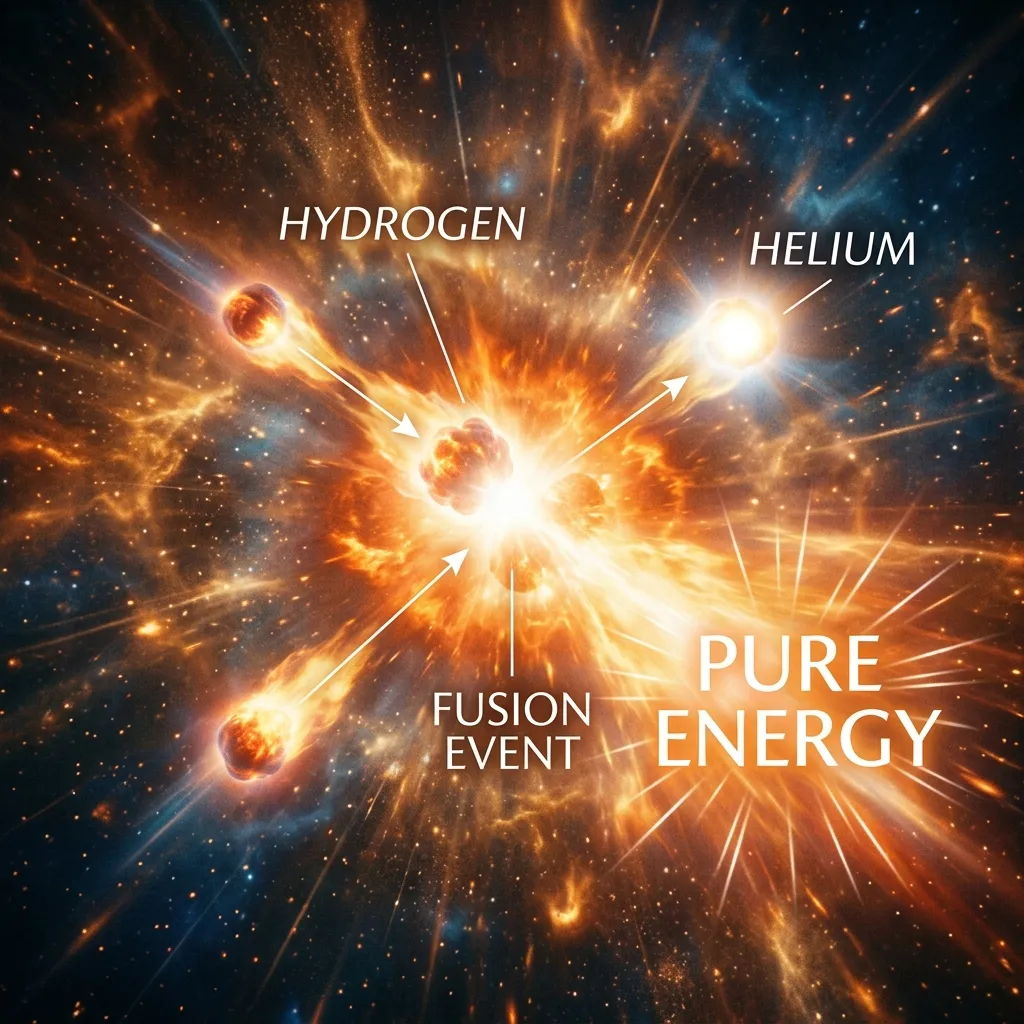 A beautiful cinematic illustration of two Hydrogen atoms colliding to create a Helium atom and pure energy
This process—where two tiny atoms are smashed together to create a brand new, heavier atom (Helium) —is called Nuclear Fusion. When those two atoms become one, a tiny bit of their mass is "lost" and instantly converted into a massive, staggering burst of pure energy.
The Battle of Giants
The Sun is actually a giant, non-stop explosion. The energy created by fusion is constantly pushing outward, trying to blow the Sun apart. At the exact same time, the Sun's massive gravity is constantly pulling inward, trying to crush everything into the core.
For the last 4.5 billion years, these two giants have been perfectly balanced. The outward explosion of fusion exactly matches the inward pull of gravity, keeping the Sun in a stable, glowing state that provides us with a steady supply of warmth.
This heat doesn't stay trapped in the core. It slowly (and we mean slowly) travels toward the surface. Because the Sun is so incredibly dense, a single ray of light can take 100,000 years just to wiggle its way from the core to the surface! Once it finally breaks free, it races across the 93 million miles of empty space in just 8 minutes, finally hitting your skin as the warm, golden sunlight we love.