
Why Is the Sky Blue?
The Big Idea
Unlock the atmospheric science behind our signature blue sky. Discover how gas molecules in the air scatter blue light more than any other color, painting the daytime sky with its beautiful, familiar hue.
Key Vocabulary & Concepts
Hands-On Observation Checklist
Teacher & Parent Discussion Starters
- Why is understanding why is the sky blue? important in everyday real life?
- What variable or factor had the biggest impact when testing the simulation?
- How does this concept connect to another science topic you have learned about?
Why The Sky Is Blue: The Scattering Game
The Scattering Game
A child asks: "Why is the sky blue?" A parent answers: "Because it reflects the ocean." Wrong. The sky is blue even in the middle of a desert thousands of miles from the sea. The sky is blue because air is a Prism. Sunlight looks white, but it is actually a rainbow. It contains all colors. Light travels in waves.
- Red waves are long and lazy.
- Blue waves are short and choppy.
The Pinball Machine
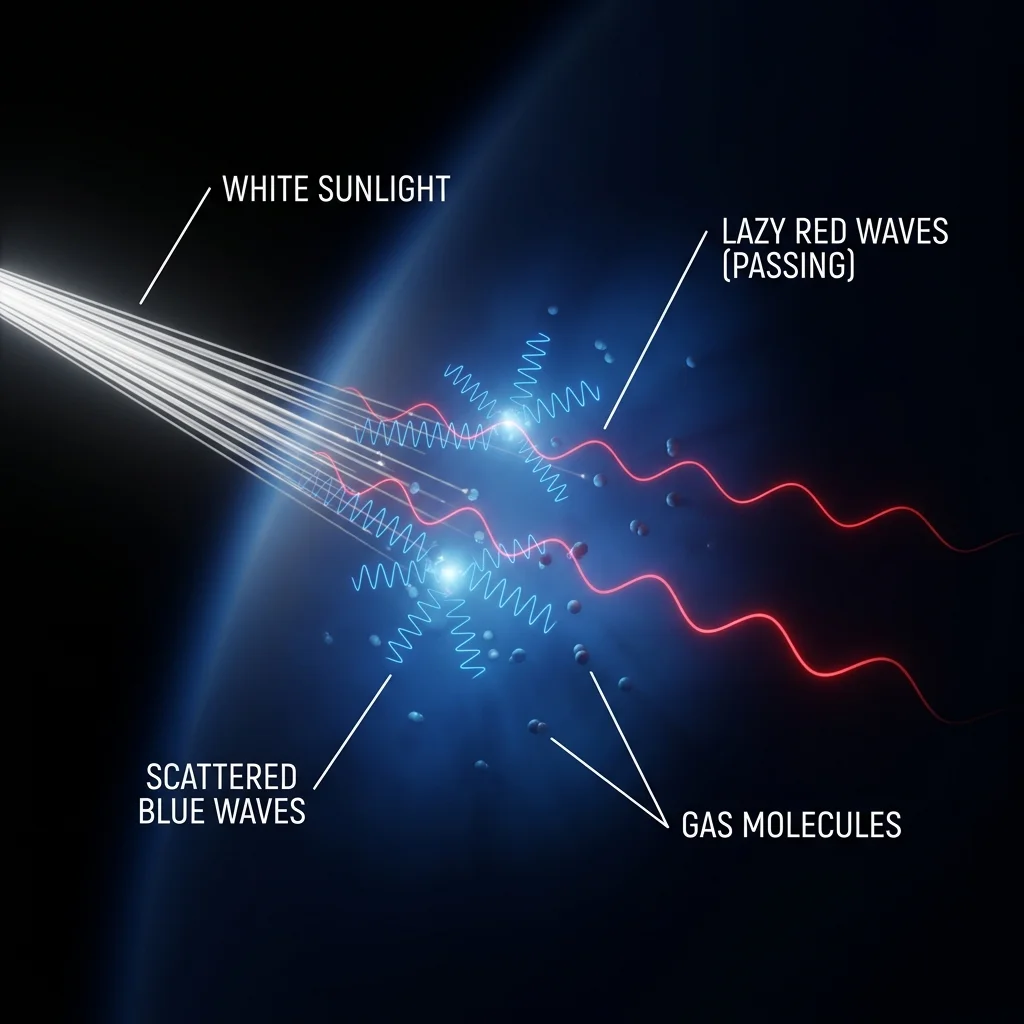
When sunlight hits the Earth's atmosphere, it crashes into billions of Gas Molecules (Nitrogen and Oxygen). This is like rolling balls through a field of rocks.
- Red Light: The long waves are like monster trucks. They roll right over the tiny gas molecules. They go straight through without stopping.
- Blue Light: The short waves are like tiny scooters. They crash into the gas molecules. Bang. They bounce off. They scatter in every direction—up, down, left, right. This is called Rayleigh Scattering. When you look up at a patch of empty sky, you aren't looking at the sun. You are looking at blue light rays that have bounced off a Nitrogen atom and hit your eye. The sky is glowing with scattered blue light.
The Sunset: Survival of the Fittest
So why is the sunset red? Because of the angle. At noon, the sun is straight up (10 miles of air). A little blue scatters. At sunset, the sun is on the horizon. The light has to travel through 100 miles of air to reach you. This long journey filters out everything. All the Blue light gets scattered away. All the Green light gets scattered away. The only survivors are the Red and Orange waves. They are the only ones strong enough to punch through 100 miles of atmosphere.
Why Not Violet?
Violet light has even shorter waves than Blue. It should scatter even more. So why isn't the sky purple? Two reasons:
- The Sun: The sun emits way less Violet light than Blue light.
- Your Eyes: Human eyes are biased. We aren't very sensitive to Violet. So the sky is technically a mix of Blue and Violet, but our brains ignore the purple.
The Green Flash
If you watch a sunset over the ocean, don't blink. At the very last second, just as the tip of the sun disappears, it might turn bright Emerald Green. This is the Green Flash. Why? The atmosphere acts like a prism, separating the colors of the setting sun. Red sets first. Then Orange. Then Yellow. Green is the last color to set before the Blue/Violet (which is scattered away). For a split second, the "Green Sun" is the only one visible on the horizon. It is real, captured on camera, and famously hard to see.
Fast Facts
- Black Space: On the Moon, there is no air. No scattering. So the "sky" is pitch black, even when the sun is shining.
- Blue Mountains: Why do distant mountains look blue? It is because you are looking through 50 miles of air between you and the mountain. The air scatters blue sunlight into your line of sight ("Airlight").
- Martian Sky: On Mars, the sky is Red during the day (Dust scatters red) and Blue at sunset (Blue punches through better). It is the reverse of Earth!
Diagram Prompts
- Rayleigh Scattering: Sunlight hitting atmosphere. Red arrows go straight through. Blue arrows hit dots (atoms) and bounce in all directions. Label: "Blue Gets Bounced."
- Sunset Geometry: Earth. Person A (Noon): Sun overhead, short path through air (Blue Sky). Person B (Sunset): Sun on horizon, long path through air (Red Sun). Label: "Distance Filters Light."
- Tyndall Effect: A glass of water with milk. Flashlight shining through. The water glows blue. The light coming out the other side is orange. Label: "The Do-It-Yourself Sky."